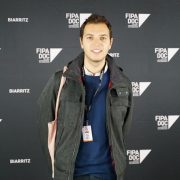
Interview of Kati Juurus, Artistic Director of DocPoint Helsinki Documentary Film Festival


DocPoint Helsinki 2022 has just unveiled its official selection. To dig deeper, we had the honour of interviewing Artistic Director Kati Juurus, for an insightful chat about the identity of the festival and its role in the Finnish and Nordic documentary ecosystems.
After celebrating its 20 years of existence last year, DocPoint Helsinki is back in 2022 to run its 21st edition, virtually, from January 31st to February 6th, 2022. Today marks the release of DocPoint Helsinki’s 2022 official selection which consists of 63 films in total, including 52 features. Among other flagship titles, this year’s International Programme includes Ascension, Faya Dayi, President and Writing With Fire, which are competing for Academy Award for Best Documentary.
On this occasion, we were honoured to chat with Artistic Director Kati Juurus, with whom we had a delightful and insightful conversation. We talked about Kati Juurus’ approach when crafting the festival’s program, the development of DocPoint Helsinki within the Finnish and Nordic documentary ecosystems, from an audience festival to an important hub for the documentary film industry, especially through the creation of DocPoint FINEST Market, as well as Kati Juurus’ relationship with documentary films. A fascinating interview, for you to read!
“I’m hopeful we’ll be able to make an even more engaging online event this year, with a film program I’m very proud of, and several online discussions and a few seminars that I expect a lot from.”
Film Fest Report: Dear Kati, can you tell us about your background? What led you to become the artistic director of DocPoint Helsinki?
Kati Juurus: At the start, political science and journalism were my early studies. I began my career as a print journalist, working for Finland’s main daily newspaper. After that, I worked in development for a while, primarily in South Asia for UNICEF. Then I went to work for YLE, the Finnish broadcasting company, as an investigative journalist. I subsequently began directing my own films and found my passion and vocation in the realm of documentary film. When I saw an opening at DocPoint Helsinki Documentary Film Festival, it seemed like a good time to try something new – which is something I have done a lot in my life, like starting as a beginner and learning the trade. And, it has been wonderful!
Film Fest Report: How can you look back at your work as artistic director of DocPoint Helsinki so far? Where are you leading the festival?
Kati Juurus: It has been very hectic, and a great learning process. I am pleased that I have been able to expand DocPoint beyond the audience festival that it has always been, and which we are very proud of, to become an organization that pushes Finnish filmmakers forward by strengthening our industry side in a significant way.
We did this by establishing competitions for both international and national filmmakers. With the upcoming edition, we are taking things even further. We are launching the DocPoint FINEST Market for Finnish and Estonian films, which will have its inaugural edition during the 2022 festival. The purpose is to create a small boutique market of Finnish and Estonian films, with a limited number of carefully curated titles. For its first edition, we will feature brand new films which are ready for acquisition, as well as a handful of works in progress – And I can already tell you that we have some wonderful works in progress! For example, we are really excited to present Pirjo Honkasalo’s new film project, as she is one of Finland’s most iconic filmmakers, having worked on both documentaries and fictions.
So, I am expecting a lot from the first edition, which will be held online, which I believe is an efficient formula, for this kind of a small market, for reaching the largest amount of relevant industry experts, and bringing them together with our national and Estonian filmmakers.
“Our festival takes place at the darkest, coldest, and saddest time of the year, thus it truly brings light to Helsinki and the people who visit and participate in our various activities.”
Film Fest Report: Like in 2021 and like many other film festivals, DocPoint Helsinki 2022 will take place online. Do you think that film festivals will be interested in keeping some of their activities online in the future?
Kati Juurus: I should say that I am a little old-fashioned in that I think of a film festival primarily as a physical event. A film festival is, at its core, a platform for meeting people, experiencing films on the big screen, and interacting with filmmakers. So I do admit that it was a disappointment to have to go online again, after the authorities’ decision to close cinemas here.
That being said, our latest edition (which ran from January 29th to February 7th, 2021) was also held virtually, for obvious reasons. We received excellent response, and after visiting a number of online festivals myself, I’m hopeful we’ll be able to make an even more engaging online event this year, with a film program I’m very proud of, and several online discussions and a few seminars that I expect a lot from. I should also point out that our festival takes place at the darkest, coldest, and saddest time of the year, thus it truly brings light and joy to Helsinki, and being a national online event, to people elsewhere in the country, too.
Finns tend to be quite techno-savvy, so I’m quite confident they will find our online programme and will enjoy it in great numbers.
Film Fest Report: What are the main themes of the official selection of DocPoint Helsinki 2022?
Kati Juurus: First and foremost, I am very much involved in the programming, along with my small but wonderful team. What I like to do first, is to brainstorm about the themes that I see emerging in society and throughout the world prior to the selection process, which allows me to evaluate the films we get through this lens.
As for this year, we have three key themes in mind for our upcoming edition. “Activism” is the first. This does not necessarily include activism films, but films that depict people’s desire to make a difference in their own lives or in the greater society. Then, I’d like to think of the second major theme as: “What do you believe (in)?”. It is centered on films that deal with the concept of belief, not just in the religious sense, but also in the political and societal spheres. It poses questions like, “Whose truth do you accept as your own?” On which facts do you choose to rely and build your own worldview? Finally, the third theme is “Identity”, which addresses questions such as: How did you come to be who you are? When you’re forming your own self, your own identity, what are you looking for?
I believe that those broad subjects encompass the intellectual, emotional, political, and social events that we observe in the world.
“We attempt to be as diverse as possible so that the selection reflects the diversity of documentary genres.”
Film Fest Report: Can you tell us about the two main festival sections: the international and Finnish competitions?
Kati Juurus: Both sections work quite differently. For the International Competition, there are no open submissions. We invite the majority of the films to celebrate their international, European, Nordic, or at the very least their Finnish premieres. Yet, it is not our intention to create a “Best of the Fest” section. We attempt to be as diverse as possible so that the selection reflects the diversity of documentary genres. As a result, we also have experimental films, hybrid works, found footage films, and so on. As I previously stated, our objective as an audience festival is to expose our local audience to a wide range of documentary styles on the big screen. Apart from YLE’s excellent work in promoting documentaries on television, documentary films have a limited theatrical release in Finland.
However, we do have open submissions for Finnish films in the National Competition. Despite living in a small country, we receive documentaries that deserve a good international life every year, which we promote by carefully selecting them.
Film Fest Report: What are the challenges documentary filmmakers face in Finland? And which part does DocPoint Helsinki play within this ecosystem?
Kati Juurus: We do have public funding sources for documentaries in Finland, and obviously, when we think of a producer struggling to make a film somewhere in Africa for example, Finland sounds like a paradise. Most documentaries receive the support of the “Holy Trinity” of YLE (the national broadcaster), the Finnish Film Foundation, and AVEK (the Promotion Centre for Audiovisual Culture). However, there has been an ongoing discussion about whether the available funding should be concentrated in a smaller number of projects with international potential, or spread out in smaller amounts, across a larger number of projects so that everyone, including new authors, has a chance to make their first documentaries. Our Nordic partners (Denmark, Sweden, and Norway) are performing better and they are more present on international festivals and markets, at least partly due to better funding. In Finland, the biggest current worry is that funding for the cultural sector is set to decrease in the coming years, with documentaries likely to be among the first casualties.
I believe we need to improve our ability to create and promote documentaries internationally. To do so, we will need to learn how to create worldwide ties and find financing from other countries. DocPoint Helsinki hopes to play a part here: we have already established ourselves as a core platform that supports our Finnish filmmakers, and we plan to take things a step further by launching our own market, as previously mentioned.
Film Fest Report: To finish, as a documentary lover, can you tell us about the films which had a particular impact on you?
Kati Juurus: Although this is a difficult question, these documentaries come to mind: I would point to Pirjo Honkasalo’s The Three Rooms of Melancholia (Finland, 2004), which we will be screening as part of a dedicated retrospective at our next festival. Then I would include Joshua Oppenheimer’s The Act of Killing (Denmark, Norway, United Kingdom, 2012), which I found absolutely fantastic in many aspects, especially from the standpoint of filmmaking ethics. It is particularly worth mentioning this film because we’ll be hosting a session about ethics and documentary filmmaking at DocPoint Helsinki in 2022, which will explore the relationship between a filmmaker and his or her protagonists. Errol Morris’ Gates of Heaven (United States, 1978) was another documentary that blew my mind when I first saw it. Finally, I’d like to refer to Kim Longinotto’s Sisters in Law (United Kingdom, Cameroon 2005), which she co-directed with Florece Ayisi. The film manages to portray heavy subjects with lightness and joy, thanks to the cool protagonists and clever filmmaking.
Acknowledgements: Kari Juurus and DocPoint Helsinki Documentary Film Festival.