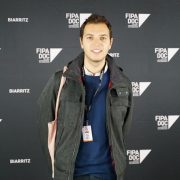
Just days before his 26th birthday, Félix Lefebvre is in Montreal, serving on the short film jury of the CINEMANIA Festival, whose 31st edition features, among its feature selections, the Canadian premiere of Trial By Fire by Aurélien Peyre — in which the young actor plays the lead role.
It’s a fitting snapshot of the effervescent career of this Val-de-Marne native, nominated for the César Award for Most Promising Actor in 2021 for his radiant, moving performance in François Ozon’s Summer of 85 (2020).
I took advantage of his presence at CINEMANIA to speak with him about how he views his already rich career, his trajectory, and what he seeks in the craft of acting.
To begin, Lefebvre dons his juror’s hat at the festival’s 31st edition to reflect on his relationship with cinema. What he looks for most in a film, he says, is “to rediscover that childlike feeling of pure entertainment or pure emotion — that magic of childhood, when you discover films and try not to think too much about the technical aspects. Like when you believe everything you see.” Yet he also enjoys, conversely, watching with a more discerning eye, to better appreciate the richness of a work: “When I see a film whose greatness I fully recognize — whether in its direction, acting, visuals, or writing — I start asking myself questions about how it was made […] and that fascinates me.”
Lefebvre first came to prominence in Ozon’s Summer of 85, where he played a teenager whose encounter with another young man, portrayed by Benjamin Voisin, sparks a fire — at once friendly and romantic — within him. The actor already lit up the screen in this generous, heart-wrenching film, where the duo’s chemistry illuminated every frame and earned both of them César nominations for Most Promising Actor.
He still holds vivid memories of that experience, though it now feels distant: “I remember it being quite a magical shoot […] but it was six years ago already,” he says. “It will always be my first time playing such a beautiful role, carrying a story of that calibre. […] It’s probably the film people most associate me with, and there’s something lasting about that, something I embrace — because it really marks my beginnings.” He admits he hasn’t seen the film since its release: “The way I see it now is really shaped by how others talk to me about it. People often mention it with a lot of affection and tenderness, which is lovely. But my own relationship with it has become more of a distant memory.”
Whether working with François Ozon, Héloïse Pelloquet (Wild Seas, 2022), Morgan Simon (Une vie rêvée, 2024), or Aurélien Peyre (Trial By Fire, 2025), what stands out about Félix Lefebvre is his candor, his sensitive smile, his endearing face — and his ability to move deeply in dramatic roles, conveying emotion with genuine depth.
“I feel that the greatest power you can have in cinema isn’t to try to provide answers, but to raise questions — to move someone through emotion. That’s the power of cinema, unlike a political speech, for instance.”

Yet Lefebvre wisely refuses to define or limit himself: “I try not to look at myself too much or categorize myself, knowing that I’m in an environment where everyone else is already trying to do that.” The film world, he notes, tends to quickly label actors after a breakthrough role or a particular genre. “There are a lot of eyes on us, trying to characterize us, to put us in boxes, to pin us down in some way — which is understandable,” he adds. That’s precisely what he strives to avoid: “I try not to define myself, to leave the field open, and not to close myself off to something I might give off. I also try to open myself to what’s less obvious for me, because I feel others won’t necessarily do that.” As he puts it: “It’s up to me to do that work — to imagine myself, so to speak, as something different, to surprise myself, and to make sure my work stays varied and never repetitive.”
Recently, Lefebvre wrapped the shoot of Léopold Kraus’s debut feature, an auteur comedy in which he explored a completely new side of himself. “It was the first time I played a character who’s completely euphoric, hyperactive, high on cocaine — from a wealthy background and convinced he’s a genius. There was something extremely exciting about playing in a register I had never really explored, embodying such an extravagant character.” It was a thrilling experience for an actor discovering a new space of freedom: “It was something that had been in me for a long time, but I’d never had the chance to express it. It was wonderful to find that sense of freedom in a character — because when you play someone liberated from all conventions, you become liberated yourself, at least for the duration of the scene. And that’s a great feeling.”
After that shoot, where the director gave him wide creative freedom, Lefebvre moved on to a project of an entirely different tone: László Nemes’s upcoming biopic about Jean Moulin. “I went straight from Léopold Kraus’s film, where I had a huge space for invention and improvisation, to László Nemes, who works with an extremely precise, finely calibrated direction. […] It was like doing a kind of acrobatic split, switching almost overnight from one acting style to its complete opposite.”
When asked which approach suits him best, he answers: “I’d say both complement each other. Doing both allows me to feel truly fulfilled.” Above all, it’s a way to keep deepening his craft: “I’ve realized how much flexibility this profession requires, and how vastly what’s expected of us can vary — as do the resources we draw upon.”