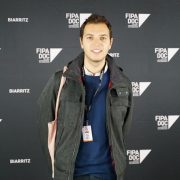
Nordisk Panorama 2021: Interview of Programmer Lucile Bourliaud (Short Films)


“What came out of the selection is a sense of hopefulness”, Lucile Bourliaud, from the short film programming team of Nordisk Panorama Film Festival, says.
As media guests, we will have the great pleasure of reporting on the 32nd Nordisk Panorama Film Festival, live from the event, in the coming days. In Malmö, Sweden, film enthusiasts and professionals will be able to discover the best Nordic documentaries and short films on 16-21 September 2021. Film Fest Report is honored to take part in the event, and one of the film sections we look forward to delving into is the short film lineup, carefully curated by Programmers Sam Groves and Lucile Bourliaud. It turns out we were lucky to chat with Programmer Lucile Bourliaud about this year’s short film program, its curation, its themes, and its main highlights.
Hi Lucile! Can you tell us about your background? What led you to the Short Film programming team of Nordisk Panorama?
Hi! I’ve been working for short film festivals for almost 10 years now, mainly in France and the UK. I met my colleague Sam Groves at Flatpack (an arts festival based in Birmingham, UK), he introduced me to Nordisk Panorama and I joined him on the short film programming team last year, after a first visit to the festival in 2019 that made me fall in love with the event and the brilliant team organising it!
Can you talk us through the selection process of this year’s short film lineup? How many films have you reviewed, what is your editorial line, and how did the team work together to achieve the selection?
We received around 400 short films. We reviewed all of them and discussed them until we achieved a selection that we were excited about, and that reflected the diversity of the Nordic countries. What drives us is the desire to find films that are original and refreshing. The quality of writing and production is important of course, but more than that, we’re looking to be surprised by unconventional forms and creative ideas. A film that is imperfect but bold often has a bigger impact on us than a film with great production values that is more formulaic. Short film is a format with a lot of freedom, where artists can explore and experiment. We love when films make the most of this freedom.
“ What came out of the selection is actually a sense of hopefulness.”
What are the main themes of this year’s short film program? What do you think this lineup tells about the world and our contemporary society?
Given the tough times we’ve been through, we could have expected heavy themes. What came out of the selection is actually a sense of hopefulness. All the films in the programme say something about our vulnerability as human beings. These characters who doubt, try and sometimes fail are portrayed with great tenderness and humour, and watching them is strangely comforting. Recurring themes include growing up (a subject that will never be exhausted!) and identity (especially gender identity – see our Body & Soul special programme). Our contemporary society faces many challenges, and I don’t think there’s any easy answer to them, but what these films tell us, very humbly, is that embracing our vulnerability can bring us closer together.
Can you introduce one or two short films you’re particularly excited to feature to Malmö audiences?
The beauty of a short film programme is that you get to discover 5 or 6 films without having to choose! But if I really have to pick two… The first that comes to mind is Cousin Helge, by Frida Eggum Michaelsen, which immediately won me over. It’s a personal documentary that mixes live action, animation, photographs, archive… Quietly heartbreaking. I can’t wait to see what the director does next.
I also have to mention The School by the sea, by Solveig Melkeraaen, one of our personal favourites this year, and an instant classic! We defy anyone to watch it without crying (or are we just very sentimental?). It follows a wise young boy as he leaves his small school and has to adapt to change.
Just like the short film programme in general, these two films are full of light and humanity. They also show what a powerful tool documentary can be to tell stories.
Finally, how would you describe the dynamics and vitality of the Nordic filmmaking ecosystem?
As a French programmer living between France and the UK, I’m a bit of an outsider, but this is interesting vantage point. Nordic films have been on my radar long before working for Nordisk Panorama. The quality of filmmaking here is impressive, and it translates into the submissions we receive. I think this is a combination of different factors: good film schools, talented producers, committed distributors and film institutes, and a great network of world-renowned festivals. It’s a virtuous circle that needs to be preserved, and Nordisk Panorama contributes to this ecosystem by offering a great meeting point.
Acknowledgements: Lucile Bourliaud, Ilja Stenberg, Nordisk Panorama.