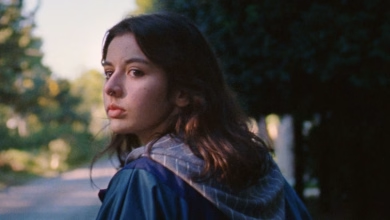
The Labour of Pain and Joy (Dir. Karoliina Gröndahl, Finland, 84 min, 2024)
The Labour of Pain and Joy directed by Karoliina Gröndahl, challenges traditional hospital practices and advocates for women’s right to choose their birthing experience with empathy and empowerment.
Why not question a practice as deeply ingrained in our modern societies, and perceived as the most advanced in its field, as childbirth in a traditional hospital?
That’s the question posed by Finnish director Karoliina Gröndahl in her documentary The Labour of Pain and Joy, which just celebrated its world premiere at CPH:DOX 2024, in the NORDIC:DOX section.
The film portrays, unfiltered, the journey of several pregnant women until their childbirth, a transformative act that profoundly changes their lives. Through her camera, Karoliina Gröndahl follows Kirsi, a midwife practicing in both hospital and home settings, and Anna-Riitta, adoula (birth companion). Passionate, the two Finnish women work every day to support their patients as best they can. They show great empathy, taking the time to listen to them. A relationship of trust gradually develops, and their patients then feel comfortable confiding in them about their fears regarding childbirth, as well as the traumas they may have experienced during previous births.
Through this film, Karoliina Gröndahl addresses a theme too rarely spotlighted in Western societies: women’s right to control their own bodies. For several generations, we’ve accepted that childbirth occurs on a hospital bed, in an impersonal setting where the woman is tended to by often overworked staff — a poignant critique also depicted by Léa Fehner in her film Midwives, presented at the Berlinale in 2023. The act concludes in nearly 30% of cases with a cesarean section, a surgical intervention involving incisions to the abdomen and uterus to extract the baby. Karoliina Gröndahl’s film shows us that there are actually various ways to give birth, and the best one is ultimately the one the woman has been able to freely choose, whether in a hospital or at home, in a specially designed inflatable pool, surrounded by loved ones, and so forth. Because the expectant mother’s mindset plays a crucial role in the course of childbirth, stress can impede the opening of the vaginal passageways. Karoliina Gröndahl’s film is not a manifesto or an anti-hospital plea; quite the contrary. Its relevance and finesse lie in acknowledging that, as it stands, public hospitals aren’t equipped to offer a satisfactory experience to women. However, if they were, they could be one option among many for women to choose where to give birth, according to their preference. By filming Kirsi at work in the hospital, Karoliina Gröndahl shows that some hospitals are beginning to reform to improve the childbirth experience for women, including by implementing specialized infrastructure like birthing tubs — allowing women to choose to give birth in water or on a bed — allocating more staff to each woman giving birth, enabling them to truly support her during these crucial hours, and training staff differently, to give more weight to consent — for example, asking the woman if and when she wants an epidural rather than imposing it upon her.
The Labour of Pain and Joy (Dir. Karoliina Gröndahl, Finland, 84 min, 2024)
In The Labour of Pain and Joy, the immersion offered by direct cinema and the camera’s positioning create a genuine circle of intimacy and provide an immersive and captivating experience. Childbirth is presented in all its reality, unfiltered, with delicacy and aestheticism. Several scenes in the film highlight the treatment of the placenta after childbirth: far from being a disgusting object, fit for disposal, it is instead magnified and immortalized through the technique of stenciling. Karoliina Gröndahl’s film is an ode to childbirth, a brutal yet infinitely beautiful act, honoring the work of those who strive to support women through it.
Aurélie is a Paris-born independent film critic and voiceover artist based in Montréal, Canada. With a passion for creative documentaries, she regularly covers prominent festivals such as Visions du Réel, Hot Docs, Sheffield DocFest, and CPH:DOX, among others. Aurélie is also a frequent attendee of Quebec's key festivals, including FNC and RIDM.