Made Here Film Festival 2024

Made Here Film Festival 2024: The Last Rhino | Interview

We interviewed director Guillaume Harvey and editor Valérie Tremblay of The Last Rhino, a visually captivating and thought-provoking short film, which masterfully blends genres to explore eco-anxiety and societal awakening, leaving audiences spellbound and eager for more from its director.

Among the rich selection of films from Quebec and New England featured at the 2024 Made Here Film Festival, which drew a sizable audience in Burlington, Vermont, United States, one short film stood out, offering a successful blend of genres on a pressing subject. The Last Rhino, directed by Guillaume Harvey, captures a specific moment in the life of its main character, Lili, a 70-year-old bourgeois Quebecois grandmother who suddenly becomes aware of humanity’s role in the disappearance of the last Northern white rhinoceros. It’s a sudden and striking awakening that clashes with the comfortable life Lili leads with her husband, friends, and granddaughter Gaby. With skill and inventiveness, Guillaume Harvey vividly portrays eco-anxiety in a very well-crafted short film.

In addition to the film screening in Burlington, we had the opportunity to speak with filmmaker Guillaume Harvey and the film’s editor, Valérie Tremblay.

Mehdi Balamissa (Film Fest Report): What or who inspired you to create the story of Lili, who becomes aware of environmental urgency and quickly develops eco-anxiety?

Guillaume Harvey (director): Four or five years ago, my sister, parents, and I regularly discussed eco-anxiety and climate change. Following that, my mother, who was nearing her late sixties and had learned a lot from our conversations, tried having similar discussions with her friends of the same age. She realized not everyone was awakening to these issues as quickly as she was.
Then my mother started telling me about dinners she shared with friends or family where she felt increasingly uncomfortable because her companions didn’t necessarily share her ideas, and she struggled with that. It’s hard to convey your message without creating conflict. Around the same time, my mother became a grandmother, which made her question the world her granddaughter would grow up in.
So, I started with this image of tense and intense dinners. Then the idea was to build a story around that.
For me, what contributed to my own ecological awakening was the extinction of the last Northern white rhinoceros; it had a profound impact on me. So, I took these two ideas and put them together.
Initially, I saw the film as a comedy of manners, where the character would try new behaviors in line with her ecological convictions. But over time, I felt I wanted to create a crescendo towards genre filmmaking, where the character’s accumulated energy and anger eventually explode.

Mehdi Balamissa: The film is visually ambitious and playful. Did you have initial visual ideas when you started the writing process?

Guillaume Harvey: In the initial ideas, I remember discussing with Valérie Tremblay, my editor; I wanted to use some terrifying archival footage, like whales with stomachs full of plastic, for example. Personally, I’ve experienced a lot of eco-anxiety episodes triggered by such images. It was a bit sadistic, I admit, but I wanted to evoke eco-anxiety in the audience watching the film.
Then, I thought I could use these types of images to move towards something a bit more horrific. Visually, I wanted to borrow some codes from horror films, like the split diopter that I really like in Brian De Palma’s work, to create discomfort.
One particularly visual scene in the film is where the main character is overwhelmed by her eco-anxiety and the rage she accumulates, going out at night to cut her neighbor’s hose, who, during the day, excessively uses water to wash his car. That’s the only scene in the film that I storyboarded. My friend Laurence Lemieux, who is an illustrator, helped me draw the scene, planning split screens. We created a kind of comic book for this particular scene, which helped convey the idea to the technical team and the editor.

Aurélie Géron (Film Fest Report): Can you shed light on choosing fiction to elaborate on your mother’s story and her ecological awakening, rather than a documentary?

Guillaume Harvey: I feel more comfortable in fiction as a director. I also saw potential in genre filmmaking. And quickly, I started imagining numerous artistic and visual possibilities. Initially, my idea wasn’t so much about the plot; it was more dramatic. Once I had written a first version of the script, it was clear that I wanted to move towards comedy of manners. But I felt there was even greater potential for me to have fun visually and not just be in reverse shots. I wanted to enjoy making the film, and that was clearly in genre filmmaking, so I quickly moved away from the documentary side, which was the basis of the story, by taking pieces of conversations my mother had with her friends, but which wouldn’t have fully fulfilled me.

The Last Rhino (Dir. Guillaume Harvey, Canada, 19 min, 2023)

Mehdi Balamissa: As an editor, Valérie, when did you join the project? Did you discuss Guillaume’s artistic choices before shooting?

Valérie Tremblay (editor): I’ve known Guillaume for ten years. I’ve edited almost all of his films, so I was involved in this film from the beginning. I read all the different versions of the script, which allowed me to give my opinion as an editor on some scenes I found less strong. We had a month for editing. We did a first assembly together, then shared it with friends. We like to take a few days break ourselves before coming back to the editing with fresh eyes and gaining some perspective. Our process is well-established now.

Mehdi Balamissa: The film skillfully mixes shocking archival footage with fiction. How did you approach this blend in editing?

Valérie Tremblay: There’s a short sequence at the heart of the film that was meant to be a “montage sequence,” as specified in the script. The idea was to show the accumulation of alarming information about climate change and its effect on biodiversity in the main character’s mind, using archival footage, newspaper clippings, etc., as well as a series of eco-friendly actions by the main character. The intention was to capture her escalating eco-anxiety. In editing, I watched a lot of the archival footage we had and managed to find relevant ways to assemble them. Particularly, and it wasn’t planned, I noticed in the archival footage an image of someone removing a plastic bag from a deceased whale’s stomach. I immediately saw the connection with an image from the film, the one of Lili’s granddaughter opening her birthday presents by tearing off the wrapping, with a similar upward motion in both cases. It’s the kind of discovery that wasn’t planned and helps to connect the different regimes of images we use in editing.

Guillaume Harvey: It’s almost a coincidence, and all credit goes to Valérie for finding this connection in editing! The work was quite time-consuming and delicate to find the archival footage we were interested in and clear the rights. Some people, including a diver who had collected hours of videos of himself swimming among plastic waste in the ocean. As soon as I found interesting footage, I sent it to my producer to ask for rights clearance. So, I sent her a lot of difficult-to-watch videos, I admit! And it’s exactly the same effect I wanted the film to have on the audience.

After a celebrated world premiere at the Fantasia festival in Montreal in summer 2023, The Last Rhino had a very honorable festival run, notably recognized at the Cinémania festival in 2023, the Colorado Environmental Film Festival in 2024, ClujShorts 2024, Courts d’un soir 2024, the Cleveland International Film Festival 2024, and more. The film is distributed by Spira. Guillaume Harvey told us he is currently working on writing his first feature film, exploring the world of child prodigies taking part in knowledge competitions in a school setting.

We wish to thank Made Here Film Festival director Orly Yadin for welcoming Film Fest Report as media partner. Watch our video recap now!

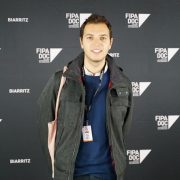
Mehdi Balamissa

Mehdi Balamissa is a Franco-Moroccan documentary film passionate who lives in Montreal, Canada. Mehdi has held key positions in programming, communication, and partnerships at various festivals worldwide, including Doc Edge, the Austin Film Festival, FIPADOC, and RIDM. In 2019, he founded Film Fest Report to promote independent cinema from all backgrounds, which led him to have the pleasure of working alongside incredibly talented and inspiring collaborators.
Back to top button