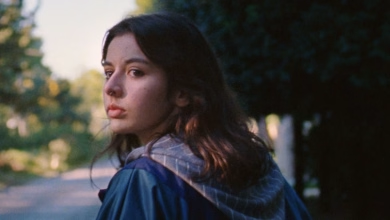
For those willing to look beyond what might appear as a demanding, slow-paced film, “A River Runs, Turns, Erases, Replaces” offers glimpses of pure beauty and poetry through its observational style, which consists of a juxtaposition of long vignettes of the city.
Don’t anticipate the film to explicitly unfold its message to you. Instead, immerse yourself in the film and allow yourself to go with the flow. Let your thoughts wander amidst the lengthy shots of the Yangtse River or amidst the numerous construction sites surrounding it. There, you’ll discover unexpected beauty. The peaceful and calming effect of the film will help you unravel its silent and hidden message. Anchored by stunning aesthetics, the film provides us with a space to delve into each of its shots. It encourages us to take the time to explore each one, to notice a detail in the landscape and follow its journey through the shot. At times, profoundly inspired, the film is visually critical and proves to be a genuinely cinematic experience.
What director Shengze Zhu captures is an ever-expanding, ever-changing city. By incorporating human presence as an element of the film’s background, the filmmaker unquestionably crafts a narrative about the city, about its shape and its soul. At a time when Wuhan has become infamous as the epicenter of the global COVID-19 pandemic, and when the city’s narrative has been appropriated by international media and observers, director Shengze Zhu, who resides in Chicago, returns to her hometown to narrate her own story of Wuhan, from within. Her tale encompasses fascination, likely tinged with nostalgia, and regret. The regret of witnessing her city being transformed by endless constructions, erasing parts of the city’s history and memories to build new infrastructure. The film captures this constantly evolving environment, perpetually altering the city’s shape. However, one element of the landscape remains untouched by this change and stays constant. As relentless as the city’s transformation may seem, the Yangtse River continues to flow and, consequently, represents the city’s past, present, and future simultaneously. The river is the custodian of everything that the city is gradually erasing. The notion of loss lies at the heart of the film. Loss stemming from the COVID-19 epidemic, but also loss resulting from the inevitable transformation of the city. In this context, four letters from Wuhan’s inhabitants are displayed on screen throughout the film. They all express regret, conveying pain from a loss, whether in the context of COVID-19 or as a result of a natural disaster. Against this backdrop, the Yangtse River becomes an allegory of life. It persists. The river and life persist. The river keeps forging ahead and flowing despite all the pain and transformation that life brings about.
All of this renders the city difficult to define. The perpetual smog enveloping the city, as depicted in the film, serves as a pertinent metaphor for a city whose appearance is hard to grasp. It appears intangible. It is ever-changing.
Born in 1987 in Wuhan, director Shengze Zhu creates an outstanding portrait of her versatile, constantly evolving hometown, which may initially seem impenetrable but evolves into pure poetry, reminding audiences of the captivating complexity found in the rich landscapes of Gu Xiaogang’s “Dwelling in the Fuchun Mountains.”