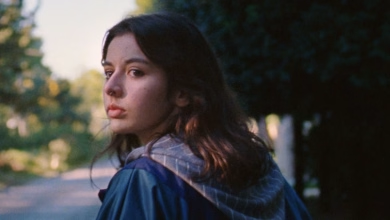
TIDF 2026: XiXi (dir. Fan Wu) | Review


For its 15th edition, held from May 1 to 10, 2026, the Taiwan International Documentary Festival (TIDF) has selected the documentary Xixi for its Taiwanese competition. For this remarkable debut film, director Wu Fan had already won the Emerging International Filmmaker Award at Hot Docs in 2024. In TIDF this year, Xixi received the Jury Special Prize.
In a poignant documentary that strikes just the right tone, Wu Fan portrays Xixi, a young woman torn between a fierce desire for freedom and her role as a loving mother. The film explores intergenerational trauma and examines the social impact of societal norms on the process of becoming an adult, becoming a woman, and becoming a mother.
The film is touching, funny, and intelligent. Wu Fan approaches the filmmaking with great sincerity. The characters, portrayed with stunning authenticity, are treated with great open-mindedness. Although the film is told from Xixi’s perspective, it maintains an air of honesty. It seeks neither to justify behavior nor to pass judgment.
A Free Woman
According to Xixi, “We are neither completely free nor completely unfree: it all depends on how we perceive things.” This confession, slipped into the documentary, reveals a great deal about the complexity of her character.
Wu Fan portrays a strong and unwavering woman, fiercely attached to her freedom. We thus discover a free spirit, unable to function if confined. In a memorable scene, after she improvises a percussion performance in front of her mother, her mother suggests she record this fantastic rhythm. Xixi then loses her temper and explains that the beauty of the performance lies precisely in its ephemeral, unique, and unrepeatable nature. Her art, like her, rejects all ties.
Parallel to this, the female body plays a central role in the actions taken to demand freedom. Several scenes in the film illustrate this reclaiming of the body.
The dance scene between Xixi and Wu Fan is a striking example: naked and bound by ropes, the two women use movement and artistic expression to symbolically free themselves from their chains. Later, alongside Xixi’s mother, the three women shave their heads, marking a collective liberation. One becomes free by reclaiming one’s body, but one reclaims one’s body when one is free.
The film portrays, with rare sincerity, open-mindedness, and without the slightest judgment, the journey of this young woman who refuses to bow to society’s rules. Even after the birth of her daughter, she chose to leave, to travel.
But how can she reconcile this quest for freedom with her desire to be a mother? This is where the film’s central tension lies. On two occasions, the director asks her if she feels restricted in her life with her daughter, or frustrated by the situation. Xixi admits that she does, but adds that even without her daughter, other problems would have arisen.

A Loving Mother
Although Xixi’s heart firmly asserts her desire for freedom, the film accurately reveals another facet of her personality: the deep love that binds her to her daughter. We understand that she will do anything to stay by her side, even as she longs to break free from the conventional mold dictated by society
Throughout the film, Xixi goes to great lengths to stay with her daughter. In the second half of the film, we even follow Xixi as she fights a legal battle to obtain a visa that would allow her to remain in France and not be separated from her daughter.
The film draws on a video diary that Xixi has been keeping for years, reinforcing the emotion and authenticity of this love. We see her, with touching ingenuity, documenting her interactions with her daughter. The affection that ties them together is clear and palpable in every frame.
The introduction of this second video medium offers a particularly successful shift in perspective. This collaboration, told in the first person and without judgment, works wonderfully. The scenes between mother and daughter are brimming with tenderness, and it is precisely this intimacy that draws the viewer into what they see on screen.
It quickly becomes clear that Xixi is grappling with intergenerational trauma. Her relationship with her own mother comes into play: she defines herself in opposition to her mother. After leaving her father, Xixi’s mother saw her only sporadically during her childhood. Unable as a child to make sense of this distance, Xixi developed a deep resentment. She speaks about this in the film, and these confessions are deeply personal. We see the two women in Beijing, where the mother, a strong-willed and funny woman, engages her daughter in discussions about the past and the meaning of life.
Throughout the film, the viewer is invited to ask themselves: can freedom truly coexist with love? And what are its limits?

The Director’s Involvement in the Narrative
In this film, the director skillfully and sensitively weaves her way into the narrative. The story revolves around this female friendship and serves to underscore Xixi’s message. Wu Fan appears in moments that seem suspended in time, somewhat ethereal, captured in abstract imagery.
Wu Fan says : “By weaving together XiXi’s video diaries and my voice-over contemplation, diving deeper into the memories and experiences that hinder me and XiXi from living our lives, the film is an effort to give a tender look at the vulnerability that one might experience in exercising agency. We make a sincere attempt to investigate and challenge inherited beliefs, creating a space for dialogue on the political questions of society’s acceptable values and how all these affect the innermost part of a person’s life. By creating this reflective distance, the film explores hopes and challenges of making one’s own path.”
Wu Fan draws a poignant parallel between Xixi and her grandmother. The director identifies with her model by creating a connection between her grandmother’s story and Xixi’s. Xixi manages to embody what Wu Fan’s grandmother was never able to achieve: freedom. Indeed, the director’s grandmother, constrained her entire life by social norms at the expense of her happiness, ultimately took her own life. This parallel, as brutal as it may be, illustrates the idea that Xixi must free herself as much as possible from societal dictates in order to continue living.
Wu Fan’s fascination with Xixi undoubtedly stems from this family history. The director, in fact, quotes her grandmother’s words to define her subject: “Like stones, humans are born with edges and corners.” Xixi is edgy, and that is precisely what makes her unique, which is what prompted Wu Fan to make a film about her.
These interventions are executed brilliantly. Rather than imposing herself on the screen, Wu Fan acts as a guide, illustrating the philosophical thoughts that might cross the viewer’s mind. Her comments, both subtle and powerful, reveal her to be an attentive and admiring observer. In a way, she becomes an extension of the viewer on screen.
By following Xixi’s journey and her friendship with the director, we discover a true ode to freedom, a heartfelt cry for the reclaiming of women’s bodies, an essential prerequisite for attaining that much-desired freedom.

Our team is on site for the 2026 Taiwan International Documentary Festival (TIDF), from May 1 to 10, 2026.