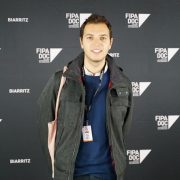
To mark the release of the Berlinale Forum’s 2021 official selection, Cristina Nord discussed the artistic identity of the section and talked us through its selection process.
Today, the Berlinale Forum, an independent section of the Berlinale, organised by the Arsenal – Institute for Film and Video Art, unveiled its 2021 official selection, which will be presented to the film industry members from March 1st to 5th and to the public from June 9th to 20th, 2021. We wanted to learn more about how this selection was achieved and to reflect on the identity of the Berlinale Forum, which stands for daring aesthetic perspectives and reflections on the boundaries of filming conventions. We were honored to have a conversation with Cristina Nord, who has been leading the Berlinale Forum since August 2019. In this interview, not only did we dive deep into the selection process of the Berlinale Forum, but we also exchanged insights and thoughts about the way we look at artworks and the impact of the current pandemic on filmmakers’ work. Read on!
Hello Cristina! Can you please introduce yourself?
Cristina Nord: My name is Cristina Nord, I have been the head of the Berlinale Forum since August 2019. Previously, I worked as a film critic and editor for “taz. die tageszeitung”, a German daily newspaper, for nearly 14 years. But before joining the Berlinale Forum, I used to work for the Goethe-Institut in Brussels, where I was in charge of cultural programming in South Western Europe.
What led you to the head of the Berlinale Forum?
Cristina Nord: I think that what led me to the direction of the Berlinale Forum was the combination of the deep knowledge about cinema and filmmaking that I had been developing as a film critic, and my management abilities that I acquired while in Brussels, at the Goethe-Institut. I think this was a relevant and tempting combination for the Arsenal – Institute for Film and Video Art.
What makes the Berlinale Forum a unique place for films?
Cristina Nord: The Berlinale Forum is dedicated to a kind of filmmaking which is really pushing the boundaries, and which is trying to find new ways of cinematic expression. At the same time though, there is a huge interest in reflecting the medium itself. Therefore, and for example, a lot of films that we showed last year were not only films that were dedicated to a certain topic, but they were also dedicated to themselves, insofar as they were questioning their own strategies, they were questioning their own methods. So, this type of self-reflection is also a very important aspect of the films showcased at the Berlinale Forum. What is more, we feature films which have to do with society, not in the sense that they contain a political message, but rather they try to approach societal and political issues through a highly reflective approach. So, basically, at the Forum, we showcase a cinema which is open to question itself.
Can you share with us one or two examples of titles that were shown last year and that represent the identity of the Forum?
Cristina Nord: I think a good example is a Spanish film called A Storm Was Coming (Dir. Javier Fernández Vázquez) that we screened last year, and which tried to talk about something which happened in Equatorial Guinea during the time of the Spanish Colonial rule. The film deals with an unsuccessful uprising that happened at the beginning of the 20th century. But it is also a film about how this particular moment of history has been remembered both orally in Equatorial Guinea and in written form in Spanish archives. At some point in the film, one can see some photographs taken at the beginning of the 20th century. However, the movie itself encompasses the debate about whether it is relevant to show photographs dating back from the colonial era, because they risk to perpetuate the colonial gaze. So, in this context, the film decided to show those photographs for a very brief moment before they faded to white. This way, one knows that those images exist but cannot really grasp them, and the violence these images contain is banned. This type of reflection is a great example of what we look for at the Forum.
Another relevant example is a film called Ouvertures, that was not done by a single filmmaker but by the collective effort of the “The Living and the Dead Ensemble”. The film, which involves a theater group from Port-au-Prince in Haiti, tries to shed light on the historic figure of Toussaint Louverture. By developing a very aesthetic and open form, the film starts to question the “siècle des Lumières” during which – while Europe was seeing itself enlightened – slavery was still prevalent in Haiti. On top of reflecting on the contradictions behind this idea of enlightenment, the fact that the film was made by a collective of people and explored new collaborative ways of film production was very interesting in the end.
Before you get to showcase such layered, thought-provoking films, you have to select them. Can you tell us about the organization of the selection process of the Berlinale Forum?
Cristina Nord: Overall, around 2,000 films are submitted to the Forum each year. And after the selection process, we end up with roughly 35 films. Quite a lot of people are involved to achieve this selection of a very small fraction of the submitted films. We have people involved in pre-selection and then we have consultants based all over the world. They provide us with insights not only from their region but also from their specific field of expertise. For instance, we are working with a programmer based in Indonesia who covers Southeast Asian filmmaking, we also have a consultant programmer who is very knowledgeable about queer cinema, etc. So, it is a blend of regional and aesthetic expertise. Then, once the consultants and pre-selection committee think that a film is worth seeing by the selection committee, we review it. In the selection committee, we are five people, and we are all based in Berlin so we can watch the films together. It is not always possible, but we prefer to watch them together in the cinema, which, luckily, we managed to do this year, despite the pandemic. Afterwards, either we all agree that a film should make it to the final selection, or we discuss. What is more, since it would not make sense to have a program with 15 films from the same country for instance, we have deep discussions regarding a combination of factors in order to craft our final program.
As the head of the Forum, how do you interact with the other members of the selection committee during the selection process?
Cristina Nord: There is no general rule but of course, being the head of the section gives me the privilege to say “no” if I really do not want to show a particular film. On the other hand, I also have the privilege to say that I really want to show a film. But usually, I try not to make use of this privilege too often because I think it is a process and that, as a team, we all have to be happy with the selection.
When it comes to works of fiction, when we identify a film which follows a structure we have seen too often, we will not select it because, at the Forum, we want to show works of fiction that try to create new, unpredictable narratives. As a result, a lot of films we have in the program are far from perfect and might be fragile. They are also unpredictable and that is what we find appealing about them. Yet, the fact that we value bold, innovative films that also bear some weaknesses, leads us to have very lively discussions! When discussing the films, sometimes half of our team sees the beauty in a film whereas the other half sees its pitfalls and shortcomings. But this is part of the process and we value this teamwork a lot.
For information, some festivals claim that they accept the submission of works in progress. What is the Forum policy regarding that?
Cristina Nord: We totally prefer a picture locked version. A work in progress is very hard to judge and too many things might change. So, in order to be able to consider a film for a selection, we need to have seen the picture locked version.
Once you are done with the selection, what are the next steps? How do you help promoting the films you have selected?
Cristina Nord: At the Forum, we think that film talks are very important. So, during the festival, the filmmakers are around and take part in extended Q&A sessions after the screenings of their film. We have a fantastic group of moderators who present these Q&A sessions and we also have in-depth film talks with the filmmakers, moderators and people with a special expertise related to the films. Last year, we also had a panel day on the occasion of the 50th anniversary of the Berlinale Forum.
So, what we try to do is to create a space for film culture to flourish and to develop and we hope that this space helps these films that are maybe not as accessible as the high-budget productions shown in the Competition of the Berlinale. Creating this space also gives a context for these films, which, I think, is something crucial. Another thing that is interesting for the films we showcase is that a lot of festival programmers attend the Forum which gives them the opportunity to be considered by other festivals as well.
As far as you are concerned, and as a cinephile, do you think that the way you see and receive films has evolved over time?
Cristina Nord: Definitely! I think that, to a certain degree, the way we perceive art and artworks has a lot to do with societal circumstances. For instance, one thing which really changed my perspective was the #metoo movement. At that moment, I had the feeling that something became public, something that I had perceived beforehand and that I had sometimes tried to express but which could not find any echo nor any resonance at the time. And suddenly, 2015 became a historic moment when you could finally talk about it. And in a certain way, it turned out that this changed my perception of cinema.
Let me give you an example. In September 2020, the Arsenal organized a retrospective of Michael Mann’s films. I saw his debut Thief (USA, 1981) and I was completely fascinated by the beauty, the style, the light and the darkness of the film and especially of its opening scene where, as the viewer, you cannot see everything that is happening. It was so attractive that I was highly intrigued by the film. But over the course of the movie, you can see the main male character behaving towards women in a very inappropriate way. This does not seem to be problematic for the film. His behavior is presented just like one of his character traits, and he can still be loved despite his behavior. There is also a very hard to stomach scene where this character acts very brutally towards a young woman, forcing her into a restaurant and then into his car even though she wants to leave. But in the end, she follows him and falls in love with him. It was like a male wish fulfillment fantasy and it seems that in the 1980s people did not feel the need to question this. And I think that in hindsight, getting an idea of the misogynist nature of a huge chunk of filmmaking and of a huge chunk of the film industry has changed my perception. Which is also a dilemma! Because as a cinephile, you realize that the films you cherish at the same time exclude you as a human being or give you a position that is not very comfortable.
I think that the idea we have about an artwork and about the autonomy of an artwork are not carved in stone. It is something which does evolve. And even though classical cinephilia may not want to learn anything about racism or gender inequality in film history for instance, I think we are at a point in history where it is important to open up to these demands and to these ideas. I am far from saying that Michael Mann’s films should not be shown, of course not. But I think there should be a space where you can voice these concerns and where they can actually be heard.
To finish, what would you like to say to the filmmakers who are considering submitting their work to the next edition of the Berlinale Forum? And which message do you want to send to the filmmakers whose projects may be altered by the pandemic?
Cristina Nord: Firstly, I would like to encourage each and every filmmaker who considers submitting his or her film to the Forum to actually do so. We will be very happy to discover their work from October 2021 during our selection process.
Secondly, I think that the situation is tough for everybody. Obviously, it is far tougher for some people than others. However, I also perceived that having to face constraints might help filmmakers to develop a certain creativity and to come up with ideas. I can totally understand when people are depressed and lose their patience. On the other hand, the very moment when you start to create a process of finding your response to the constraints can be something very precious, because in that moment you can connect to a potential of creativity and ingenuity which is outstanding. I was very surprised to see how many films were produced during the pandemic and during the lockdowns and how a lot of filmmakers could react to these difficult and tedious circumstances.
We would like to thank Cristina Nord and Sebastian Sury for their time, kindness and help in organizing this interview.
Learn more about the Berlinale Forum and the Arsenal – Institute for Film and Video Art.