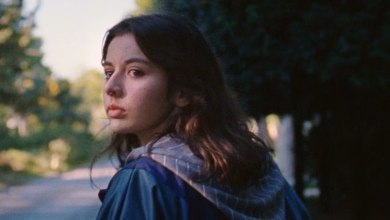
Cannes 2026 (Un Certain Regard): All The Lovers In The Night | Interview with Yukiko Sode


With Japan as the Country of Honour at the Marché du Film, the Land of the Rising Sun is also well represented at the 79th Cannes Film Festival, where filmmaker Yukiko Sode is a contender in the Un Certain Regard section for her film Subete no Mayonaka no Koibitotachi (All the Lovers in the Night). At Cannes, the director and her two lead actors, Yukino Kishii and Tadanobu Asano, discuss adaptation, generational fear, and the loneliness that Tokyo both creates and conceals.
Yukiko Sode is a filmmaker who refuses to stand still. Known for Aristocrats, a quietly devastating portrait of women navigating class, desire, and the myth of Tokyo, she is at Cannes with All the Lovers in the Night, an adaptation of Mieko Kawakami’s novel that charts a tender, age-crossing love story between two people who are, in very different ways, prisoners of their own caution.
Both Aristocrats and All the Lovers in the Night orbit women living in Tokyo, some born there, some transplants, belonging to different social worlds. Asked what connects the women she depicts across her two features, Yukiko takes a pause before her reply: “When you’re living away from your family, alone in Tokyo, and something goes wrong in your love life, I think women tend to snap at each other, little arguments, little irritations. But then there’s always a moment of truce. Whatever was happening, they stop and they take care of each other. That solidarity among women living alone in the city, I think that’s the common thread.”
The film’s central love story, between Kishii’s younger woman and Asano’s considerably older man, touches on something that feels increasingly fraught in contemporary Japan: the younger generation’s complicated relationship with risk. She is frank about the gap she observes. “I’m not part of the younger generation anymore, so this is only my impression from the outside. But what I notice is that they seem terrified of failure. Our generation grovelled, we threw ourselves at challenges, failed constantly, and that failure made us stronger. This generation is smarter, more careful. They avoid mistakes well. But the flip side is that when even one small thing goes wrong, it hits them devastatingly hard. And that fear makes them reluctant to try, in work, in life, and yes, in love.”
Yukiko’s filmography traces a quiet arc, from confused teenagers to marriage, cohabitation, and now a love story between people at very different life stages. She traces this not only as artistic growth but as a natural consequence of curiosity. “When I was making films at university, I could only depict a world with a radius of about five metres around me. But gradually you start to explore what you don’t know, inhabit characters whose emotions you can’t fully access. That inevitably makes your world bigger. And once I’ve made one kind of film, I have no desire to repeat it. So the change is both organic and deliberate.”

As a director, she has developed a reputation as an unusually assured adaptor. Her approach to Kawakami’s source material is, by her own description, pointedly un-reverential. “Leaving the original work unchanged is not respect,” she says. “What is respect is taking the core, the essence of the material, and finding how to express it in the language of cinema. That’s why I adapt quite freely. And the same principle extends to my actors: if they have something they want to express, I try not to get in the way of that. Their contribution is part of what makes an adaptation live.”
For Yukino Kishii, the challenge of playing Fuyuko was not the age gap in the love story — she had read Kawakami’s novel years before and had never once questioned that configuration — but the difficulty of releasing a character she had carried inside her for over a decade. “I understood in my head that the film has to exist independently of the novel, that’s how you truly honour it,” she explains. “But emotionally, extracting myself from the Fuyuko I had already formed was the hardest thing. I had to layer in a new, external image of her, one I could observe from the outside. I had to go through the process of becoming her again, from scratch.”
Tadanobu Asano reflects on a different dimension of the role: the social weight Japan places on age-gap relationships. “In Japanese society, there is this moment before you even register your own feelings where you start measuring yourself against convention, you shouldn’t love someone this much older, you shouldn’t love someone this much younger. In Tokyo you have anonymity, so you can sidestep that. But the moment you go back to your hometown and face your family, you’re back to reality. Maybe you end up giving up what you wanted. It’s suffocating. And if a foreigner has genuinely never had to think this way, I think Japanese people would envy that.”
The conversation closes on Tokyo itself, as it is also the setting of the film; the city that quietly underpins every film Yukiko makes, a place that offers freedom to some and a kind of beautiful dislocation to others. Since she hails from Kanazawa, a country girl at heart, she offers a wry observation. “People who are actually from Tokyo tend to be surprisingly straightforward, quite ordinary. The Tokyo that most people imagine, that electric, complex city, is really just a mosaic of everyone who arrived from somewhere else.”
Our team is on site for the 79th Cannes Film Festival, from May 12 to 23, 2026.