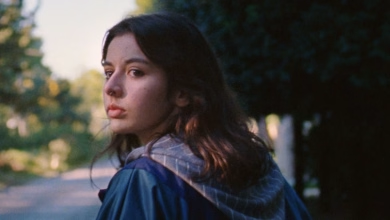
Cannes 2026 (Un Certain Regard): All The Lovers In The Night (dir. Sode Yukiko) | Review


When was the last time a film wrapped a warm mug between your palms while wars raged and inflation soared beyond your door? Perhaps once or twice. But if that warmth has never reached you, or if you ache for a quiet corner of cinema in which to catch your breath, director Yukiko Sode has the key. In All the Lovers in the Night, don’t worry if you’ve lost faith in affection. A tiny new cell of care may begin to form the instant the film starts.
It may sound almost too dreamy, but the film carries a deep, unmistakable magic. Fuyuko (Yukino Kishii) moves through her days as a freelance proofreader — solitary, homebound, her talent spilling across pages. Yet this is no mere occupation. It is her pulse of concentration, a quiet ritual that keeps her aligned with the solitary self she knows best. Hijiri (Misato Morita), her colleague, is everything she is not — louder in spirit, bolder in ambition. At night, Fuyuko walks beneath the trees, listening to their soft songs, watching the world breathe. She finds solace in anything that lives and remains. Then, on an unplanned evening, drunk from curiosity after trying alcohol for the first time, she is approached by Mitsutsuka (Golden Globe winner Tadanobu Asano) — a stranger who turns out to be a physics teacher in his 50s. They meet, they converse, and they begin having soul-searching discussions until those encounters become ritualistic, moving steadily toward what feels like a profound destiny.
The film presents an irony at its core: the process of personal evolution — traits emerging through experience and relationships — simultaneously becomes the foundation upon which identity is built. Director Sode and writer Mieko Kawakami (whose novel of the same name serves as the film’s source material) build the narrative around the idea that happiness can exist in isolation — a perspective often dismissed as inherently negative. Fuyuko learns to find her own kind of fulfillment in solitude; isolation becomes her medium. Yet life never moves in a straight line. Slowly, the film shifts toward human bonds, whispering that the finest connections are among life’s rarest treasures.
You might hear echoes of Linklater’s Before trilogy conversations, but the pulse here beats differently — it is the science of nature, of light and what it does. Not heavy, not cold. The true fascination lies in how Fuyuko fuses fact with fate, as though the world had hidden a syllabus inside every leaf and ray, and she is slowly gathering the fragments as she walks. The film grants significant weight to the concept of safe spaces, embodied in Fuyuko’s conversations with Mitsutsuka — exchanges that both educate and reassure. The gradual growth of comfort, though familiar, emerges here as a necessity. Ultimately, it propels both Fuyuko and the audience toward an active reconstruction of life’s worth.
Shinya Takata’s sound design functions as an additional character, actively shaping the film’s emotional core: the preservation of connection. Less aggressive than Apichatpong Weerasethakul’s Memoria, its approach echoes Hirokazu Koreeda‘s naturalistic audio work in Maborosi — sea waves, domestic silence — and Ryan Machado‘s wind-through-forests atmosphere in Raging. The film presents itself as a silent dialogue between an individual and her environment, offering a form of tranquility that surpasses collective social spaces. It adheres closely to a singular subjective perspective, elevating the importance of the protagonist’s emotional and reactive states. These radiate outward, producing a quiet emotional spread across the viewer as we observe Fuyuko navigating her existence.
When Fuyuko and Mitsutsuka speak of light, inspiration gathers like a key turning inside a lock, slowly unlocking her attraction. Their words drift into something almost dystopian — a fantasy born from an age that never stops breaking. And through it all, Sode guides us into a world rarely glimpsed, rarely touched — and somehow, impossibly, it moves us.
This Un Certain Regard selection offers a deliberate, step-by-step exploration of life — a film that would make Terrence Malick and Nuri Bilge Ceylan proud. Produced by Toshikazu Nishigaya and Kana Matsuda, All the Lovers in the Night is also something of a blessed paradox: conversations become a stage upon which hidden feelings are revealed, and the entire experience turns therapeutic, helping us discover both the magic and the anomalous dimensions of human existence. This is a film that reveals the hidden beauty of loneliness to those who have never seen its treasures. At the same time, it shows us how even fleeting connections — like passing clouds — can shape us into necessary versions of ourselves, giving us the strength to endure our own limits and expectations.
There is a line here: “At night, only half of the world remains.” And in that half-light, irony finds its perfect seat — right place, right time — for those who only wish to hold close the smallest circles. What begins as a whisper can turn into an eternal shift.
Our team is on site for the 79th Cannes Film Festival, from May 12 to 23, 2026.