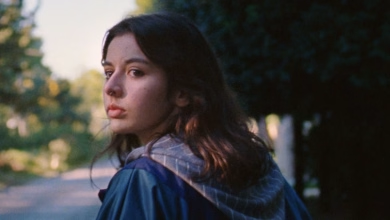
Cannes 2026 (Un Certain Regard): Forever Your Maternal Animal (dir. Valentina Maurel) | Review


The food on the table goes untouched. Amalia has no interest, and neither does her sister Elsa. They aren’t really talking about the meal. Elsa is simply trying to reach across the silence and understand her sister better. And Amalia, who never buries what she feels, lets a story fall — abrupt, uninvited, and far from happy. Elsa grows quiet, frozen, almost afraid to imagine the scene that has been painted for her. Almost instantly, Amalia’s fury erupts. She shouts at Elsa for her silence — a reaction that doesn’t match what Amalia had hoped for. Or maybe her anger comes from somewhere else: she’s furious at a chaotic world that offers no solid ground. Amalia leaves, and Elsa remains in a static state — one where she feels utterly defeated.
Watching director Valentina Maurel‘s films always feels like taking a masterclass in invisible connections. And this time, the lesson arrives wrapped like a gift — goodie bags bursting with intense feeling. We meet Elsa (played by Daniela Marín Navarro, who appeared as Eva in I Have Electric Dreams), returning home after years in Europe only to find that the lock on the front door has been replaced. And the changes keep coming. Elsa discovers that her sister, Amalia (Mariangel Villegas), has quit school and is now spending time with a strange new crowd. Meanwhile, her mother (Marina De Tavira) has begun republishing the erotic poetry of her youth. As Elsa struggles to process all of this — while also dealing with her own layered issues pressing in from the edges — the ties between the women in her family grow increasingly tangled, spreading into an entirely new landscape of transformation.
Let me start by acknowledging how effortlessly Maurel has created something that almost feels like a spiritual successor to I Have Electric Dreams, while shifting the focus into a completely different universe. We see three generations in the midst of crisis, but this isn’t dark or mysterious — rather, it is an affective phase that must be endured. Maurel trains the camera on the shape of womanhood itself, where attraction and repulsion coexist, and somehow each woman finds a way to bridge those opposites within one another. The characters bond in ways that feel almost absurd, even pulsating — yet those same connections manage to spread hidden depression far and wide. They act as catalysts within their familial circles without ever directly naming it, but when they truly invest their hearts, the emotion flows like a river. What makes the film feel fresh and strangely magnetic, though, is that it finally places onscreen the age-old dilemmas between women and those unexplainable, uncharted territories that cinema has rarely captured so honestly.

The film also questions how freedom operates: How far can it go in giving women the fulfillment it promises? The existential tremors that arrive at any age; the automatic savior instinct that rises from family blood; the bold thoughts that breed a strange, unorthodox strength; and the need to remain present, even on ground that cannot be fully understood — these are the nuances that transform complicated decisions into blessings in disguise.
These women carry the film’s emotional weight, and we feel them deeply through the three central performances by Daniela Marín Navarro, Marina De Tavira, and Mariangel Villegas. Personally, I found the film’s sensibility aligned with Simón Mesa Soto’s A Poet in the way it manifests through the screenplay. It offers audiences something unexpected, simply to remind us that life cannot be manufactured or planned, because it is already as abstract as it will ever be.
Forever Your Maternal Animal (original title: Soy Tu Animal Materna) reads like an open letter, stirring up the uncertainties, absurdities, and soft wounds of women across every age — while somehow extracting a raw form of realism from them. It’s a one-in-a-million experience, the kind that might genuinely be called cinematic brilliance. Every subtle layer builds toward an explosion of emotion — a beautiful mess wrapped in warmth. This Un Certain Regard entry feels like a blessing: exactly the kind of cinema that should always be celebrated and cherished, because its emotional truth feels timeless.
Our team is on site for the 79th Cannes Film Festival, from May 12 to 23, 2026.