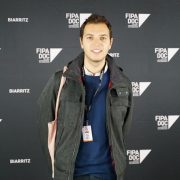
DOK Leipzig 2020: Downstream to Kinshasa | Interview with Dieudo Hamadi


We interviewed Congolese Documentary Filmmaker Dieudo Hamadi on his latest film, Downstream to Kinshasa, recently awarded the Golden Dove at DOK Leipzig, a powerful tribute to a resilient community who has been fighting for its rights for 20 years.
For two decades, the victims of the Six-Day War in the Democratic Republic of Congo have been fighting in Kisangani for the recognition of this bloody conflict and demanding compensation. Tired of unsuccessful pleas, they have finally decided to voice their claims in Kinshasa, after a long journey down the Congo River, documented by filmmaker Dieudo Hamadi in Downstream to Kinshasa, with whom we were lucky to chat.
Film Fest Report: Hello Dieudo Hamadi! Thank you very much for being with us today for a chat about your latest film called Downstream to Kinshasa, which has just been awarded the Golden Dove at the DOK Leipzig festival in Germany. This prize is another recognition for your film after a lot of festival selections like Cannes, Toronto, etc. However, this is nothing new to you as an experienced filmmaker with a rich filmography including: Kinshasa Makambo, Atalaku, Mama Colonel, National Diploma… To begin with, could you please refresh our minds on what Downstream to Kinshasa is dealing with?
Dieudo Hamadi: Thank you for the question. Downstream to Kinshasa is a film about a forgotten war in Congo, a war that is no longer spoken of. We suffered this war in the 2000s, so it’s already been almost 20 years now. This war opposed, on the streets of Kisangani, my hometown, two foreign armies: the Ugandan and Rwandan armies. Both armies fought for 6 days, causing a lot of damage… Both material and human damage… And I, as a Congolese who was born and raised in this area, now that I’ve become a filmmaker, I think it was both necessary and important for me to be able to tell this story that, unfortunately, is not much spoken of nowadays.
Film Fest Report: Alright! To begin with, we can comment on the opening scene of your film, which is both powerful and poetic. It deals with a theatrical performance, delivered by the survivors of this Six-Day War in Kisangani, and that we’ll get to see again at multiple times throughout the film since the film alternates between their journey and this theatrical performance. What is beautiful is that we can see those people who have visibly been injured and mutilated. However, they are on stage anyway. They are shining, thanks to the colour (color en anglais US) of their clothes and the lighting. They are beautiful on this stage. It looks like this scene sets up the topic of the film and the way you want to look at those characters. Can you tell us more about the way you looked at those characters, knowing that you were raised in Kisangani and that you experienced the Six-Day War yourself?
Dieudo Hamadi: My intention was to show in the film the impression I had when I first met those people. I mean that when you meet them, you need no more than 30 minutes to forget about their physical condition. Because they have been mutilated as you mentioned… But what struck me was that at some point, you could only see their dignity, their humanity and their fighting spirit. And from the beginning, I wanted the film to show this first impression I had had. And I think it’s a beautiful metaphor for the mindset of Congolese people, for the people of my home country. In spite of our history, the repeating issues, the wars, the political instability, in the end, we haven’t lost our humanity. And for most of us, I think that we still hope that the future will be different. As a filmmaker, it was very important for me to show this mindset that is shared by a lot of people in my country. We think there is no fatality, even though the context that surrounds us could push us to give up. So, those people, those victims that I have filmed in this movie, are exceptional because of that. We understand that they are not only the victims of a war, but that in the end, humanity has not left them despite everything they went through in this war. And it was very important to be able to stress that and show that. Then, regarding the theatrical performance, I thought it was a nice opportunity that there was a theatre troupe within the victims’ association. In the beginning I was very interested in what they were doing because they wanted to perform their theatre piece, that they are used to performing in Kisangani, in Kinshasa too, once they’d got there after their journey. They wanted to perform this piece to raise awareness among the inhabitants of the capital about this forgotten war, hoping that, thanks to theatre and comedy as a means of expression, a lot of people would support their cause, and maybe they could end up getting some sort of compensation. That was the initial plan: to use their abilities as performers to have their voices heard once in Kinshasa. But as you saw in the film, we arrived in Kinshasa in the midst of a tense electoral context, to the point that they were not able to accomplish their initial plan and raise awareness about their cause. I gathered many sequences from their rehearsals, that I filmed differently than I would film their daily lives, because I needed to show a distinction between their daily lives and what they would do on the stage. So, when editing the film, we agreed with the editor that it’d be relevant to use those images of rehearsals in contrast with what the film tells of their daily lives. That’s how we came to this idea, and the film shows those images of rehearsal at different stages throughout the story.
Film Fest Report: This is fascinating! I have 1,000 questions regarding the editing process, what happens in Kinshasa etc. But in order to bounce back on what you’ve said as to the fact that humanity has not left those people, I think this is something which transpires a lot in the film. What’s very beautiful is that we can see them fighting with dignity. And the numerous sequences where the characters are walking serve as a good metaphor for this idea. Those sequences allow us to see that they are injured, they have a hard time walking. But at the same time, they are standing and they are moving forward. And this is a great illustration of this idea. As the film progresses, there is a part that is very important and crucial to this film which is the journey of the characters from Kisangani to Kinshasa. They are not flying or driving to Kinshasa, but they are going down the Congo River. Practically, how did you deal with this trip? How long was the trip? How does a filmmaker work in such complicated conditions? How did you charge your camera? How did you become accepted by the other passengers? How was your relationship with them? I think you’ve had to film with your phone at some point… So how did you deal with this trip? And how did your relationship with the characters evolve during this trip?
Dieudo Hamadi: I must confess that what got me excited about this film project was this journey, which I had never done myself. I had been dreaming about discovering Congo’s hinterland from the River, about discovering my country through this journey. So, as soon as they decided to head over to Kinshasa, it was obvious that they could only go there via the River, because there is no road between Kisangani and Kinshasa, the capital city. And flying was obviously unaffordable… Flying inside Congo is one the most expensive ways of traveling. Flying from Kinshasa to Paris is sometimes cheaper than flying between two Congolese cities. So, in this context, the only way they could travel was by boat. As far as I was concerned, I was surprised because I didn’t know how people used to travel by boat. I thought we’d travel on a real boat with compartments. But I realized it was just a skiff, covered by tarpaulins, that were supposed to protect us from the bad weather. And, since I had some time after arriving in Kisangani and before the departure of the boat, because they had to postpone their trip several times – because they had not collected all the money yet, or because the boat was not full enough to be able to leave… As all this delayed our departure, I took the opportunity to prepare myself. Given the conditions in which we’d travel, I got a generator so I could charge my batteries. I also gathered supplies of water and canned food for the duration of the trip. Then, I had to deal with the fact that there were a lot of passengers who did not easily accept the camera and the fact that I kept filming, to the point that I decided to film with my phone. I filmed most of the sequences on the boat with my iPhone, which made it easier to deal with the other passengers. They would see me as a tourist and no longer a filmmaker which allowed me to do pretty much anything. And then, we were on our way, without any idea of what would happen! What is exciting about making documentaries is to deal with the unexpected. We embark with a few ideas in mind, an intention, but we don’t know what the film will look like in the end, what we will tell, what we will stumble on… But I kept my initial idea which was to follow these characters in their quest, and I stuck to it. Despite what would happen, my purpose was to follow their quest and show it through their eyes. I think it helped strengthen our relationships. In the beginning, some of them were wary and suspicious… They didn’t know me and wondered why I was joining them on this trip and had not shown up before. But they saw that I was taking the same risks as them. We spent about a month and a half on this boat… We experienced a lot of problems: issues with the engine, silting, bad weather… We even collided with another boat, which we can see in the film. There, it took us a long a time before another boat could leave Kinshasa and tow our boat. Because our boat was almost fully out of use. And we were all very scared. I was scared and I guess them too! And as we went through all that together, they ended up being convinced that I was not making a film against them, but that I was like them and by their side. In the end it went well and we supported each other. At some point, after this accident, I was no longer able to film. We ended up somewhere we couldn’t get fuel or anything. All my batteries were down. And at this moment, I was no longer a filmmaker but rather a regular passenger, like anyone else, waiting for help. So, that’s pretty much the story of this journey.
Film Fest Report: It’s incredible. What’s powerful is that while your ties with the characters have strengthened during the trip, our empathy towards them, as viewers, gets stronger during this trip too. Not only is there a great proximity between the passengers, but we also feel close to them thanks to a lot of close-up shots. Then, it’s interesting to notice that when we arrive in Kinshasa, we’re getting an altogether different perspective, we’re getting the outside world’s point of view. After seeing the characters very big in the frame during the trip, we now see them smaller in the image, in the midst of the urban setting. We realize how small they are compared to the country’s political institutions. How have you experienced this transition between a group supporting each other and making plans of claiming their rights and their very complicated arrival in Kinshasa where we see them rejected multiple times? How have you dealt with this evolution among the group and how have you managed to keep making your film?
Dieudo Hamadi: First, I must confess that as a Congolese myself, I found their project a little bit naive. I actually live in Kinshasa where most of them had never been to before. Their city of Kisangani, which is also my city, and Kinshasa are extremely different on so many levels. Kinshasa is a very populated capital city, it’s much bigger and the political institutions are out of reach. So, when I heard them talking about the trip to try it all for the sake of it, after seeing their claims for compensation ignored for 20 years, when I heard that they were determined to go to the capital to keep up the fight, I knew they didn’t know what to expect. On the one hand, they were fed up, which I respected. I thought: “let’s see what happens!”. And, again, as a filmmaker, I had this opportunity to make the film because of the trip on the Congo River which was at the core of the idea I had for the film. But I also wanted to show on the picture what I was expecting from this trip. That is, when they arrive in Kinshasa, what will happen to them? And how are they going to interact with the city? That’s why I decided to shoot with shorter lenses in Kinshasa, to have wider shots, so I could have the viewer feel how derisory was all this pain they had gone through, the terrible setbacks along the way… And then they were arriving in an effervescent city, in a turbulent electoral context. And it was very important for me to show this contrast between the characters, the victims with whom we’ve gone down the River, and the mere Congolese arriving in their capital forced to deal with the reality of their country and their capital, with the insensitivity of the leaders, the indifference of the other citizens… Even myself, after I arrived in Kinshasa, the film was no longer my priority: I needed to charge my batteries in every sense of the word. Our paths kind of slowly separated. I needed to have a shower, change my clothes, take some rest, while they were continuing the fight and keeping being rejected, and so forth. It couldn’t have happened differently though. And we can feel that in the film. On the boat, we were kind of confined. And since I was on the boat too, the only way to film them was by being close to them. In Kinshasa though, I kind of returned to my life meanwhile they were keeping up their fight. But I kept working on the film. I had to show the reality as it was unfolding. That is, this city is very complex even for the people who live there. Therefore it is also the case for people who have just arrived, who have never been there before. So, it was important to show this disillusion in the film in one way or another.
Film Fest Report: It’s true that we can definitely feel this tipping point in the film, which generates frustration and disillusion both for us and for them. This made me reflect on a famous sentence by Lao Tseu, who used to say: “The goal is not the goal, this is the way”. It means that in every process, the goal is not the goal per se but rather the path to get to it. Do you think we can apply this sentence to the film, by saying that the journey, that is at the core of the film, is where the characters have the more things to take away? Like resilience, supporting each other, showing solidarity… I have the impression that we can also interpret the bad weather and all the setbacks you went through during the trip as a metaphor for all the obstacles they encounter in their lives. So in the end, what’s essential for them is to be able to go through this situation and overcome it together? Do you think we can interpret the film this way?
Dieudo Hamadi: In the film, definitely. Even when I knew that their project was going to no avail, to my eyes, what seemed important was this determination to fight even if the battle is already lost. And this is still the case, as we speak. Actually, all the rejections they suffered when they arrived in Kinshasa are not what’s important. What is valuable is this humanity that I’ve mentioned earlier, this thirst for life in spite of everything. And this is a beautiful life lesson. At least for me, they taught me a lot. Especially at the human level. They are people who teach you a lot about life. And it was great to show it in the film. However, as far as they are concerned, I don’t know to what extent the trip was something necessary? Has it changed their perception of their own lives? I have heard some of them, who have returned to Kisangani who ended up very disappointed and wondered for what did they take all those risks? They thought they were still at square one, even in Kinshasa. So, a lot of them went back to Kisangani. Whereas some others are still, as we speak, in the streets of Kinshasa, trying to raise concern about their situation. Unfortunately, nothing has changed for them so far. Except a few promises, nothing has changed so far. So, we must draw a parallel between the film and their lives as victims, which has not evolved despite the trip. I think some of them even wondered whether it was worth embarking on this trip or not. But what remains in the film, and that is important to my eyes, is the testimony of their courage and their vital strength.
Film Fest Report: To broaden the perspectives, I have a question regarding how the film was built and assembled, both during the shooting and editing phase. During the shooting, similarly to your previous films, we can see that you follow the tradition of “direct cinema” which you manipulate in a very relevant way. Has your practice of “direct cinema” been evolving over the course of your filmmaking career? How have you evolved in the practice of “direct cinema”? And then, in the editing – we easily realize the amount of work that was done as you edited this film, I guess you came back with long hours of footage. So, in the editing phase, what were your main intentions? And which other directions could the film have explored based on the footage you brought back? So, to sum up, what about your use of “direct cinema”? And then, how did you manage the editing process?
Dieudo Hamadi: So, today, after making 5 feature films and 2 short films, I think that I cannot consider making documentaries without using “direct cinema”. I think this form of vulnerability in front of reality, in front of the unexpected is more exciting for me. And, despite everything, by sticking to an intention, we always manage to make a film out of the footage. I don’t know if I’d be able to make films without using “direct cinema”. However, with a bit of experience, now I know that shape alone is not enough. In the end, the ultimate goal is to manage to convey a message to the viewer with what we’re filming. That’s why I included the scenes of theatrical performance in the film for instance, because I thought it was necessary. Using footage in which somebody comes and talks to me directly doesn’t even bother me, as long as it is spontaneous and interesting in view of the story. So, I like using “direct cinema” very much but I am more and more open to other approaches which can exalt the shape and strengthen the story, and add poetry, and so forth. This is what I feel like I’ve learnt after all those years of experience. Then, regarding the editing, I must confess that we didn’t find how to assemble the film right away. Simply because, I have filmed a lot. And I used to film based on a breakdown of the story that I had in mind. The beginning was supposed to take place in Kisangani, to introduce the characters and get ready for the trip, then the trip itself, etc… But sometimes this structure would not work when we were editing the film. We hesitated between building the film around a main character, Sola, the girl, around whom would gravitate other characters, or, we could have done a film about a group, with all the characters on an equal footing. We hesitated a lot… We hesitated about the theatrical performance too. How could we use it? When? Before we got to the final cut, we tried out a lot of other possibilities. As a result, the editing took us a long time. And finally, we had to leave a lot of my initial ideas on the side. A lot of scenes which I had filmed with an intention, ended up not being consistent with what the film was becoming. This is what’s exciting about making documentaries! Even when editing the film, we keep looking for its best possible shape and many possibilities remain open. And finally, I think that we’ve managed to keep the initial intention and to find a consistent shape.
Film Fest Report: It’s really fascinating! “Direct cinema” has definitely a one-of-a-kind ability to create immersion and empathy. But it’s true that afterwards, when editing, there’s a lot of work to find the right balance for the film. It’s exciting to get a sense of what happens behind the scenes, thank you for sharing! Let’s move onto one of my last questions: Your film is being showcased at a large number of festivals, most of which being held online this year, which may prevent you from meeting with the audience. What does this visibility given to your films outside of Congo bring to you? And, in contrast, how do Congolese audiences react to your films, when they are able to see them?
Dieudo Hamadi: We don’t make films for ourselves. We make films so they are seen. And when they are seen and they get recognition, it’s very important for an author and a director. And there’s nothing like the human warmth of a movie theatre, in a festival, where people clap or react to the films, but it looks like the world is changing, and, anyway, I have attended more festivals from my living room than any other year before! And I don’t regret that because it was important to show this film… If it could have been screened in front of an audience, just like a few festivals have actually done, it would have been nice of course! But I admit I’m happy I didn’t have to travel the whole world to talk about the film, which I have done from Kinshasa. I was still able to talk with a lot of people who shared their feedback with me, as well as how the film has made them feel. In this regard, not much has changed: I know that the film speaks to people, and that’s what’s important. Here in Congo, the film will be shown to an audience for the first time next week, as part of a festival called Fickin, one of the few important festivals in Congo, so we’ll see how people react to it! But most of the time, my films… It depends on the films. Some were rejected, because Congolese are a complex audience. We have very few places to screen our films, very few movie theatres, and the people who come to watch our films are often not very sensitive to the image of themselves that we portray. Even though they admit that our films show what our lives look like… But, just like for a lot of people around the world, cinema is supposed to offer evasion and entertainment, which are things I don’t propose in my films at all. And sometimes people want to see films that are not related to their own issues. That’s why we have often heated debates about the film, which are sometimes interesting too. And sometimes there’s just this pride of seeing their own stories on the screen. It’s great that our reality is getting known and shown. So, in Congo, my films are not widely distributed or well-known because we face a lack of infrastructure, and, in the meantime, the form of cinema that I practice is not very popular in Congo. Therefore, I don’t reach a lot of people, but, to me, what’s most important is that the film is done, and that it remains, just like books, so it can be evidence of our situation, as we are living it today. This is fundamental because as a general rule, we have memory issues in Africa. Our memory was built by some others. But I think that what we do as authors and filmmakers helps us start to reclaim our own memory and build landmarks for incoming generations. In this regard, I don’t mind whether my films are widely seen in Congo or not because, as long as they exist, they might, in a few years, fill the gaps that we faced as we were growing up, because nothing had been done.
Film Fest Report: It’s definitely a beautiful testimony, especially because if I’m not mistaken you had forgotten this war yourself after living it. Therefore, making this film sounds like a work against oblivion.
Dieudo Hamadi: Exactly!
Film Fest Report: Thank you so much for this insightful conversation, and congratulations on this touching, poetic and important film!
We wish to thank: Dieudo Hamadi, Maria Preußner (DOK Leipzig), Juliette Sergent (Makna Presse), Benjamin Hollis (Doc Weekly).