Venice 2026: House of The Wind (dir. Auguste Bernard Kouemo Yanghu) | Review


Josette faces the glowing eye of her laptop, reaching across oceans to gather her children into a grid of tiny screens. They are scattered, each in their own corner of the world, and this is all she has: pixels and Wi-Fi, voices that arrive with a lag. Although she responds to their casual questions with evident care, her eyes betray a persistent melancholy. She cuts through the small talk with a blade of a question: “If I die today, where will you mourn for me?” She watches the faces fall, the smiles fumble. Josette doesn’t wait for an answer, as she already knows. What hits her isn’t their silence — it’s the disappointment in her own heart, cracking open.
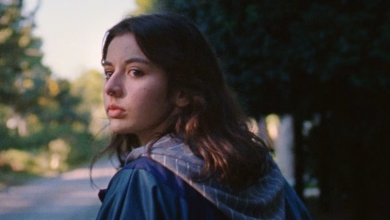
House of the Wind, presented in the Orizzonti section of the 2026 Venice International Film Festival, centers on Josette, an elderly woman living in solitude in Cameroon, her children having relocated abroad. She undertakes the construction of a house as a means of enticing them to return. This project represents her personal initiative — a tangible expression of her desire to reunite her family. She pours herself into it, brick by brick, beyond her strength, beyond reason — because longing knows no limits. During a visit to the registration office, Josette discovers that her identification card is missing. She encounters a young woman named Sarah (Moudjeu Pouadeu), whom she initially suspects of having taken it. Upon confrontation, however, the interaction culminates in Josette asking for financial assistance, which Sarah agrees to provide. Sarah experiences familial estrangement and awaits the arrival of a white man she is to marry in Cameroon. Sarah requests that Josette assume the role of her mother during this encounter. Thus, an agreement is reached — as both women pursue their respective objectives under difficult circumstances, their concentration fractures and their aspirations diverge, resulting in both anticipated and unexpected transformations.
Director Kouemo Yanghu gives us two women from different generations, both carrying their own version of desolation. They’re placed in a loop — a kind of narrative mirror where they’re supposed to fill each other’s voids. It’s a compelling setup, but the film doesn’t let them off easy. The hurdles between them and that midpoint are real, messy, and numerous. What Josette craves most is to be seen, heard, acknowledged, which is also what’s hardest for her to receive. The director handles this with a quiet, assured hand, never overplaying it. This represents a universal truth regarding the elderly: they require affection and care, both on account of their physical vulnerability and in recognition of the love they have devoted to their offspring. Sarah stands at the edge of becoming a woman of the new generation, reaching for transformation, for a future she can call her own, even if her family does not approve. She believes that happiness is something she can hold in her own hands. And so we have two women, each wrapped in their own quiet loneliness, learning to find comfort in each other’s presence.
The director employs the domestic space as a metaphor for the familial structure. The wind is the people — coming, going, brushing against walls and leaving. The one who stays, who chooses to remain, holds the centre. The rest are clouds that pass through, carried by the breeze. But some clouds are different. Sarah is one of them, as she arrives and rearranges everything. This film, in so many ways, becomes the alter ego of Joachim Trier’s Sentimental Value.
Ultimately, viewers are pushed beyond narrative and into interrogation: why don’t children show empathy for parents who clearly need them? Is it okay to relegate the older generation to the role of casual acquaintances? We’re told distance is about work, but is it really — or is it a convenient kind of freedom? And if that’s what it is, does it actually mean anything? The hardest question: why are there so few elderly care homes in Cameroon?
The music of Michel Duprez and Blick Bassy does not just accompany the film; it holds it. Each musical note guides us through sorrow, through joy, through the quiet spaces where both live together. The score breathes balance into every scene. Actress Josette Kwanya inhabits Josette like a second skin — recalling the fierce presence of Professor Annalise Keating (Viola Davis in How to Get Away with Murder), yet entirely in her own, relentless manner. Her walk, her will, her unshakeable ambition — she carries them through every hurdle, as if she were born to overcome.
For all its worth, House of the Wind is a luminous and affectionate film that rests its palms on loneliness while fighting its own system to show us a new world of independence through the eyes of two bold women with different perspectives. The film weaves a mother-daughter bond not through blood, but through the spaces where wounds live. And in those spaces, the director shows us redemption — a breakthrough that declares: women of any age are not merely fighters, they are their own salvation, and if the world shakes apart, they will hold it together with the strength they’ve always carried. It presents a juxtaposition between a protective parent and an autonomously raised child, who are nonetheless positioned in proximity to one another. We observe their divergent trajectories toward the future as the boundaries between reality and performance become obscured. The agreement — never meant to be real — becomes the only thing that is. And their duties, their weights, their silences, merge in the dark. At one point, the film breezes through our eyes and hearts, capturing us in its own universe.
The film then whispers: “Is death the only thread that can stitch an estranged family back together?” The answer lives in Josette’s gaze, where shadows dissolve, walls crumble, and Sarah stands in the quiet, watching everything fall and rise again.
The 83rd edition of the Venice International Film Festival is running on September 2-12, 2026.