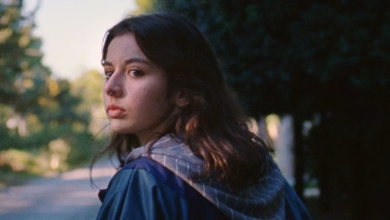
Dear Ajayi, the sophomore feature of Nigerian director Damilola Orimogunje made history as the first Nigerian film to be selected for Venice Film Festival’s Giornate degli Autori section. Orimogunje’s film is a sensitive and poetic tribute to everyday lives of two sisters Ade and Titi who approach life from opposite angles. Ade finds comfort and strength in adhering to societal expectations of her, while Titi makes space for expressing her personality in breaking the norm. Dear Ajayi, which was shot on a single lens in order to evoke the restrictive strings that society can pull over individuals, is a subtle feast for the eyes thanks to the director’s vision and Abisola Omolade production design inspired by Wong Kar-Wai. The film won the CICT-UNESCO Enrico Fulchignoni Award which is awarded to film that represent the values of peace and tolerance promoted by UNESCO.
Ramona Boban-Vlahovic: Tell me about your journey as a filmmaker. How did you fall in love with movies? And what made you choose film as your medium of expression?
Damilola Orimogunje: I think I’ve always been a storyteller. As a child I liked writing and imagining stories beyond my environment and I never thought I would ever be doing that through film. But when I got to college, someone asked me to write a radio play and they liked it and said I should do something in film. It was very random, but it lead me to write my first script and it just kept on going from there – writing the next script, thinking about the next film and so I became obsessed.
Ramona: Lucky us that it led to your film Dear Ajayi, which I really enjoyed. I loved the look of it, and how you wrote the characters. Your characters struggle with taking responsibility – partly for their family and partly for themselves as individuals. Is this resonant, this duality in Nigerian society?
Damilola: Absolutely. I think the notion of duty and responsibility are presented in all our lives and society has set these parameters within which we are supposed to work. And as humans, we’re all different and we don’t necessarily want to follow standards set by society.
This is something I see every day in African society and it’s the main conflict in the film. We have characters who are taking on this duty, not necessarily because they really want to, but because it’s the expected thing to do. It doesn’t mean it’s wrong, but the question is where to find yourself within the norms of society.
Ramona: Titi and Ade’s husband Michael are artists, and Ade is more traditional – a carer both professionally and at home. Why did you choose to make your main characters artists in contrast to Ade who takes on a more traditional women’s role?
Damilola: Mainly because of my experience as an artist – I wrote about the people that I know. But beyond that, I wanted to show how dreams and ambition collide with reality of society, economy, patriarchy…
Ramona: Even as artists, you can see how they respond differently to difficulty. Titti is assaulted at the club where she sings, but she goes back because it’s the place where she finds joy while Michael becomes desperate because his art isn’t as valued as he would like.
Damilola: Yeah, it shows the perspective from the man and the woman, because Titi’s ambition is tied to a sense of freedom she receives from her art, beyond just the idea of making money. She doesn’t want to become an artist because she wants riches and she really wants it because that is what makes her happy. The songs she sings say a lot about her and her singing is a way to speak out and even to cry for help. And it’s not just about herself alone, but for women who are in the same situation as her.
And as for Michael, in him you see the dynamics of masculinity. He wants to make it as an artist because he wants to make money. It ties into the conditioning of society where men are seen as the breadwinner and when he is not, he believes he’s not doing enough despite his wife trying to convince him otherwise.
It’s a dynamic present in African culture and Michael has to take a big sacrifice to achieve what he really wants. And the question at the end is does it bring him the happiness that he deeply wants or was it all in vain.

Ramona: I read that you worked on this script for Dear Ajayi for eight years. How did you keep the material fresh all this time?
Damilola: It began as an exploration of two sisters who didn’t like each other, but that was a very basic concept. So, with time, I started adding more layers to why they don’t like each other. And I realized there were so many dynamics that make them move and how they respond to the world. I asked myself what makes these characters true and what makes them who they are. That’s why it was essential to have this long time to understand them and it also allowed me to grow as a filmmaker and as a human being and I could do justice to the material.
Ramona: You set your story in the nineties. What did that time period allow you to do that you couldn’t do in present day?
Damilola: To me, the story is also very nostalgic. My childhood happened in the nineties and I wanted to paint characters that I have seen growing up.
Ramona: I also want to focus on the look of the movie. The framing and the set design are so beautiful, like looking at a photographer’s portfolio. And then the choice of colours is striking because the recognizable vivid African palette is present in Titi’s club and then in Michael’s paintings. But the rest of the movie is quite dull and blue. Can you explain how you chose the visual style?
Damilola: Thank you for your compliments. I personally think there is beauty in sadness. That’s why it was important for me to create a film that has beauty, despite all the tribulations and desperation that the characters go through. The colours also represent the things that we don’t know how to express verbally such as melancholy and depression. So these are the colours that I used to represent such feelings.
Also, we shot the film on one lens – the 100 mm. And the reason is that we wanted to tell the film from one perspective. We wanted the audience to feel like they are intruding in these people’s lives and they’re watching it from one perspective, the one opinion. In some ways it felt restrictive, but, in the end, it added to the poignancy of the story.
Dumebi: The characters Titi and Ade are two very different people and they show two different aspects of what Nigerian womanhood is like. Was it your intention to make the sisters such opposites from the beginning?
Damilola: I grew up watching my mom and my younger sister act like that. One moment they’re the best of friends and the next moment they’re arguing about something. I realized that there was love in these huge amounts of conflict because of misunderstandings. Then again, they are a mirror to the society itself. I believe I am quite observant and I saw that even in the best of families such conflicts arise and that’s what inspired the sister dynamic.

Dumebi: I would also like to know about the ending. Why did you decide for Titi who was so full of energy and dreams to suddenly get married and take on a traditional role?
Damilola: The ending is something that I thought about for so long and we considered multiple options, such as ending it on a very bright note and have Titti win at the end of the film. And she did win, but not in the way we like to think about winning.
It was also important for me to shape the story in such a way that it honestly represents the challenges that women go through. Titi represents the people who are in this in this rat race and they can’t get themselves out of it. And a lot of people die in this race. It felt like it gave more depth to the character and it showed the truth of life. Not everybody will get that win, but there is still beauty in life regardless.
Ramona: Thank you so much for your time and congratulations once again on the success of your film.
Article written in collaboration with Dumebi Ezekeke.
The 83rd edition of the Venice International Film Festival is running on September 2-12, 2026.