
Venice 2026: A day in the life of Jo: Chapter Phaedra (dir. Jacqueline Lentzou) | Review

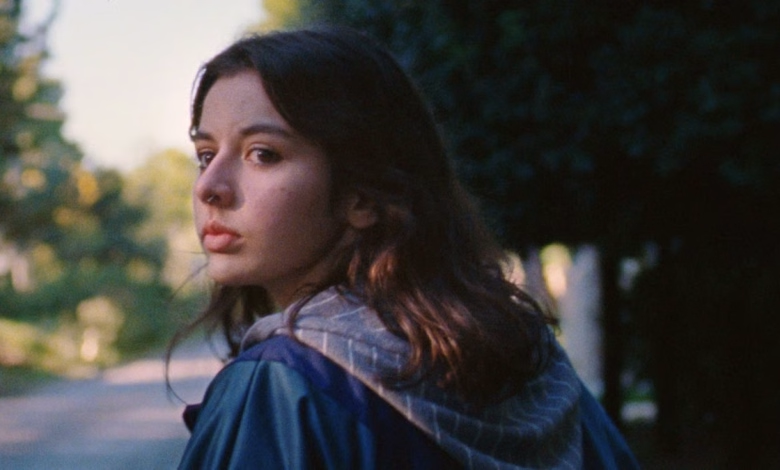
Jacqueline Lentzou’s filmography continues to explore one’s emotional state through simple stories where dreams and the beyond unlock the consciousness. Her latest film, A Day in the Life of Jo: Chapter Phaedra, builds upon her previous film, resulting in a playful, dreamy, out-of-body experience about a day in the life of fifteen-year-old, Josephine. On the surface, the ordinary premise is a bit lackluster, but through Lentzou’s superb direction and relentless approach, the film opens cinema’s capability to explore a different cinematic logic, where time and space’s boundless possibilities allows Lentzou a larger canvas to explore Jo’s internal and external emotional presence.
Lentzou has been interested in family, specifically the parent-child relationship depicted in Fox (2016) and Moon, 66 Questions (2021). Her other short film, The End of Suffering (A Proposal) (2020) uses the, let’s say, unseen entity via subtitles, to unlock a certain spirit to communicate with its protagonist amidst a crisis. After five years since her last feature, it appears that she has fully integrated all her ideas into her most ambitious film yet. These have shaped her latest film’s evocative story resulting into a fully formed, risk taking, and stimulating film.
We meet Jo already in disarray, missing her bus to school and arguing with her mom before getting a ride to school. But before that, we see Jo calmly asleep on the grass, where a soundless entity appears through subtitles. This begins the film’s logic and puts meaning to each individual sequence’s circumstance. We are under the spell of Lentzou’s, where these entities “send her the dream” and multiple signs appear. It’d be spoiler to say, so with these signs acting as a Chekov’s gun, the suspense is immediately captured. But also in the subtitled sequence depicting this transitory dream space, mainly blues inhabit the screen, with fading smoke-like whites and bubbles appearing in which Jo is somewhat aware and mentions that she “dreamed I became water.”

The daring, unconventional opening reconciles another daunting, ambitious move as the film progresses, but that’s for you to experience. With the titular Jo, there also comes Phaedra, a classmate and illuminating, but shy girl, who sings a Greek song called “The Rose Tattoo” or Triadafillo Sto Stithos by Manos Hadjidakis. Lentzou’s use of music strikes at pivotal moments in her films: Daniel Johnston’s True Love Will Find You in Moon, 66 Questions (and again in here) at a breakdown or the tribute in Fox, where Bowie’s Modern Love comes at a time of emotional and physical disaster. After being swept away by Phaedra’s performance, Jo introduces herself and invites Phaedra for a hangout later that evening. During this scene, it feels as if Jo has found a true friend, turning her exasperated mood to a spark of joy. This moment captures the excitement in companionship, as if flower blooming at its peak.
Lentzou gives us just enough of Jo’s perspective to see the current state of the world. Murmurs of a missing boy, youths yelling at cops, and fleeting moments of locals friendly with Jo. Along with the general perspective, Lentzou’s gliding camera captures the glimmering light’s reflection from the window, close-up of Jo’s mother dancing until passing out, seamlessly transporting us from the hardwood floors of the dance studio to Jo’s school gym. These in-between moments fill the narrative with a warmth of light and mystery, distilling Lentzou’s film grammar where everyday objects we’re not used to seeing give a new meaning, as well as reminding us snippets of our memories act as a filmic montage. With semiotics being one of the biggest motifs of the film, it allows us to identify the moments of our lives when either the déjà vu phenomenon occurs or our personal relationship to that one random object, song, or movie that breaks us down emotionally. Lentzou’s introspective film is a cinematic wonder that achieves a transcendent experience, crafting a singular portrayal of love and loss.
The 83rd edition of the Venice International Film Festival is running on September 2-12, 2026.


