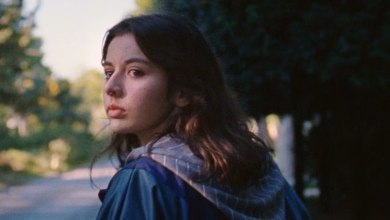
Spotlight: Female and Non-Binary FilmmakersTribeca Film Festival 2026

Tribeca 2026: What Is to Come | Interview with Ruthy Pribar

“We need some sort of hope in the world, the way it is today,” filmmaker Ruthy Pribar told us as we discussed What Is to Come, presented at the 25th Tribeca Film Festival.

Filmmaker Ruthy Pribar returns to the Tribeca Film Festival with a brand new and unforgettable story that explores healing, hope, and second chances. Pribar’s second feature film, What Is to Come is set to have its world premiere as part of the international narrative competition. The Israeli filmmaker discusses working for nearly a decade on this project before reaching the screen and how she embraces an optimistic tone. 

The film What Is to Come is a drama that tells the story of 60-year-old Yehudit (Ronit Yudkevitch), who loses her husband, discovers she has inherited his debt, and embarks on a journey to rebuild her life from the ground up. Tackling her grief, she leaves her old life behind and forms new connections and opportunities that take her on a journey embracing new beginnings. 

The Israeli filmmaker discusses working on the film for nearly a decade before it reaches the screen and how it embraces an optimistic tone.  She also discusses reuniting with her strong creative team, including cinematographer Daniella Nowitz, editor Neta Dvorkis, composer Karni Postel, and one of her biggest inspirations. 

Now, Pribar is finally getting the Tribeca premiere she missed out on, as her feature directorial debut, Asia, was selected for the 2020 festival, but was forced to move online due to the 2020 pandemic. The 25th Tribeca Film Festival is incredibly special for Pribar, and Film Fest Report is happy to share this exclusive interview. 

Kristin Ciliberto: Why was it important for you to tell this story, and why do you think audiences need to see this right now? 

Ruthy Pribar: So, when you make a film for such a long time, and I’ve been working on this film, the idea came to my mind around 10 years ago. When it’s that amount of time, then you have to keep asking yourself that question, like, why am I doing this? Why is this film important to me? And for me, the story is about being able to start over, being able to decide again who you want to be, what you want to be, where your life is heading, what brings you joy, and what makes you passionate about something. The character in the film is what she does. I mean, she’s 60 years old, and she’s had a whole life before. But the circumstances bring her to start from scratch with nothing and just make a whole lot of decisions all over again. This time, she really wants to make the right choices and to make them bring her to a place that she wants to be in, one that she hadn’t found in her previous life. I think for me, this is what the film is, this is why I wanted to make this film, because it’s always possible to start over, to understand who you want to be and to understand that you want to change. I think that’s what I want people to take with them as they walk out of the cinema and see that their lives don’t have to remain the way they are just because they are that way. They can always strive to have a better life if they want that. 

KC: This is also your second feature film. Can you talk about how you’ve grown as a filmmaker and how directing Asia has influenced your approach to this film? 

RP: First of all, I think my first feature was a very intimate and small film. It dealt with a mother and daughter and their evolving relationship, trying to make the best of it, as it’s the girl in my first film who is quite sick, and the mother is taking care of her, and she needs to really understand how to make the most of their time together. So, it was a very intimate film, and it was also quite tough, as it dealt with difficult subject matters. It wasn’t easy for me at all. Like I would cry on the set. It was very, very emotional. I think with this film, it’s also emotional, and it has difficult subject matters, but there’s also this light and this optimism that is so much in the film. The journey of the character is just about really setting ourselves free, like finding that freedom. So, for me, it was a completely different film on a very small scale and very intimate and indoors. This was much more like going on a journey. It was almost like a road film. It’s not a road film because they’re not going throughout the film, but it is like taking a ride where you don’t know what will happen, and there are a lot more characters and more subplots. So, it was really like taking a leap with this film. 

KC: With an emotional story, of course, you have some emotional, incredible performances here. Can you discuss putting this cast together and how they helped convey the themes you were trying to convey? 

RP: So Ronit Yudkevitch, who plays Yehudit, took me a long time to find her because I was searching for the right actress for so long. I’ve seen so many actresses in Israel, and Ronit didn’t even come to mind because, originally, she’s more of a model than an actress, though she’s, of course, acted before. I know her more as a model and presenter. She was so beautiful, always in my eyes, that I felt like the character needed to be a bit rougher, and I didn’t imagine her as beautiful as she is, so we didn’t invite her to audition for the role. But as time went by and I saw so many actresses, I couldn’t find the qualities that I was looking for, which was, on one hand, this strength, this inner strength, because this character, I didn’t want her to be a victim, because she’s been in this marriage where she was not being who she wanted to be. She was just there living this life as a farmer, growing tomatoes and just living her life, but she didn’t really live it to the fullest. I didn’t want it to seem like she was a victim of her own life. I wanted her to still be strong and be able to make this journey. And this is on the one hand, and on the other hand, I needed her to have this fragility within her and almost childlike qualities, like she could learn how to whistle during the film, and it would be like a surprise on her face, almost looking like a child learning to ride their bike. This was what I was looking for, and I couldn’t find it because it’s quite, you know, two opposite qualities. When Ronit entered the audition room after we decided to try everything we could see she really nailed it the first time, and I really felt like she was the character because I’ve seen so many actresses before, I didn’t even need to rethink this, like I automatically knew this was her. 

KC: I also really enjoyed her chemistry, like Yaakov Zada Daniel. You shot this in Eilat. Why do you feel that Eilat was the right place for this story, and what was it like filming? 

RP: It’s a city that is really at the southeast point in Israel, like by the border with Egypt. I was looking for a place that would be as far as possible from our home, which is in the village, in the countryside, very green and lush and with these beautiful tomatoes, and I just wanted it to be as far as possible, like the way it looks and the way it feels. Then it just made sense for it to be in a lot, which is in the desert, and it’s yellow and hot. It’s very, very different from where she comes from. There’s, of course, the beach over there and a lot of hotels because it’s a tourist city. It’s all surrounded by the beach, but there’s also the outskirts of the city, and that’s full of really worn-down buildings that no one’s paid attention to in years and a lot of refugees coming from the border with Egypt, refugees from Africa. It’s just that it brought a lot of texture and stories to the film, and I remember that when I was first writing it, I knew I wanted to go to Eilat, but I didn’t know about the subplot with the African family. That was not in the script originally. Then, when I went to Eilat, I saw all these people and really huge complex buildings filled with African refugees. And then I said, okay, she is herself a refugee from her own life. And it made so much sense for her to be in this situation with them. It’s like a lot was built for the story, or it was built around it. You can not separate them. 

KC: I know you’re working with some of the people again who worked and helped you with Asia. What was it like working with them, bringing them onto this project, and what were some of the biggest challenges that you faced while making this? 

RP: First of all, I love working with people that I’ve worked with before. It just creates such a difference because you don’t need to explain as much. Like, we have the same sort of language, um, especially with Daniela, my cinematographer; this is the third project we’ve collaborated on. We just don’t even need to talk too much. We understand each other without words, and we just send each other references, films, images, or locations. And we’re like, yes, this is it. Or we just know each other so well, and we agree on so many things that it’s really easy to work together. I think that’s great because then you also don’t need to look for new people and see if the chemistry works. When it works, it works. It’s just wonderful. It was like coming back to work with friends, which is the greatest thing. As for the biggest challenge, I would say that it is to work with a kid. He doesn’t have the biggest role in the film, but just the fact that you need to, in a way, get something from a kid that’s so hard because he was less than six years old. He’s having a lot of fun on camera, but he doesn’t understand why he needs to wait so long for his shot and then for another. We could only shoot four hours at a time with him. We had to have a backup, like a double, for scenes where he’s sleeping, or we’re seeing him from the back. So, it was really difficult to have a kid on the set. He was full of energy and just running around and jumping on the mattresses, on the floor and it was really like quite an adventure. 

KC: Yeah, I’m sure it was. I know working with kids on films is incredibly challenging. I know a lot of other filmmakers have expressed that as well, but I would love to get to know you more as a filmmaker. What are some of the filmmakers, writers, or storytellers that inspire you? 

PR: I think the number one director that comes to mind is Krzysztof Kieślowski, the Polish director. I love the way his films are so human, tell human stories, and make you feel a lot of love and tenderness for the characters and what they’re going through.  Although it may be difficult at times, given his subject matter, he still always finds a way to portray himself with a lot of love and respect. That’s something that, in general, I’m looking for in cinema and in films and in art, maybe because we need it. We need some sort of hope in the world, the way it is today. And at least I need it. I feel like films that show me how horrible the world is, which I already see in real life. It’s not that I’m looking for escapism; it’s not that, but it’s just a way to see that there is goodness, and I believe that, and I tried to do it in my own films as well. See the good in people, definitely so.  

KC: I really loved What Is to Come as it’s a story about second chances and healing. You’re having your big premiere at Tribeca. You had Asia premiere there back in 2020. Such a different time in the world, a very strange time in the world. What does it mean to be returning to Tribeca and having that rightful premiere? 

RP: Wow, it’s really an opportunity, a second chance of getting a second chance in getting our premiere because the festival got cancelled last time when we weren’t cancelled, but it was online, and we couldn’t get there, and it took a really long time until we saw the film with an audience in a cinema. It took, like, I think, a year and a half, maybe later, once the cinemas opened and started opening up. It’s the fact that the film is coming out and people are gonna see it, and I’m gonna be there to see them watch the film. That’s gonna be like a really, really exciting and emotional experience for me and for the rest of the crew and cast that are going to be there. I’m sure it’s going to be wonderful, and I’m really looking forward to it.

Our team is on site for the 25th Tribeca Film Festival, from June 3 to 14, 2026.

Kristin Ciliberto

Kristin has been inspired by and loves films. She grew up going to the theater with her family deciding later on to make this her full time career. Kristin has her Masters Degree in Screen Studies and has always loved watching independent films as well as the big budget cinematic films as she is a true film enthusiast. She is a former Assistant Editor for Video Librarian and has written for Celebrity Page, Scribe Magazine, and Sift Pop.

Related Articles

Back to top button