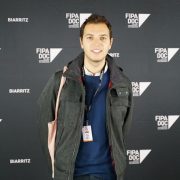
In Montreal for the world premiere of Mystik at the CINEMANIA Festival, Raphaël Quenard sat down with us to discuss the making of this offbeat, generous comedy, a fable of sorts about the search for love and recognition, revolving around a cat who gives the film its title.
In Casseneuil, a small village in southwestern France’s Lot-et-Garonne department, Lionel is a municipal police officer whom everyone makes fun of. He is the polar opposite of his childhood sweetheart, Angèle, who has since become a television star and a source of local pride. So how can Lionel finally turn his luck around when Angèle returns to the village for an evening in her honor? By making off with her cat, the star of her TV show, and then taking charge of the search himself, all under the watchful eye of an increasingly distraught public.
The origins of Mystik can be traced back to a meeting between Raphaël Quenard and Azedine Kasri, the film’s two co-directors, during an improvisation-based acting class. Kasri had come up with a scene centered on “a platonic, irrational love for an animal.” It was enough to set Quenard’s imagination racing. The two began working on a short-film script titled Frimousse. Later joined by Guillaume Scaillet, a graduate of France’s prestigious La Fémis film school, the trio eventually decided to expand the project into something bigger: a feature film.
“We never set out to make a comedy,” Quenard explains. The inspiration, rather, came from the rural communities where both co-directors grew up. “We come from towns and villages about the same size as the one that serves as the film’s setting. We know the kinds of characters who populate it, and we’ve heard many of the things we put into their mouths before. The film carries a part of who we are.” The result is a colorful cast of characters, each with a distinct personality. “We love the way they speak, their vulgarity, their poetry… Their whole way of being in the world.”
Reflecting on his dual role as director and actor, Quenard notes that being behind the camera helps him “work through some of an actor’s neuroses.” He explains: “I usually ask for a lot of takes. If I feel there isn’t perfect chemistry or that exhilarating moment of suspension emerging from a scene, I ask for another take.” Being at the helm of the project and subsequently having a say in the editing process helps put to rest his “fantasy of getting the perfect take, in its entirety.” As he puts it: “When you’re an actor, you can lie awake at night wondering whether you were good enough. But as a director, you can relax. You know you have enough material to work with in the edit. It takes away quite a few doubts and anxieties. Manageable anxieties, mind you—artist’s anxieties.”
Quenard readily lists the names of the actors and actresses involved—including none other than Magalie Lépine-Blondeau, Hakim Jemili, François Cluzet, Emmanuelle Bercot, Eva Huault and Ragnar Le Breton—toward whom he says he feels “eternally grateful for agreeing to appear in a film of such modest proportions.” Yet the film’s real star is none other than Mystik the cat.
The feline seems to have given its leading man an even harder time than his faithful canine companion Malabar did in Jean-Baptiste Durand’s Junkyard Dog (Chien de la casse). Asked which of the two animals he prefers, Quenard gives a remarkably detailed answer: “If I had to choose based on how obedient the animal was, I’d say Malabar, even though he was reluctant to do what he was told. But Mystik took things to a whole other level when it came to defiance and a rebellious streak. He never obeyed. Not once, I don’t think.”
Among the tricks the crew tried, ultrasonic devices and food seemed to work best. Then there were more specific tactics: “If you put a bird in a cage, that catches his eye. That works pretty well.” Beyond that, “it’s all down to luck.” Shooting the final scene, in which Mystik was supposed to run toward a hot-air balloon, cost the crew a good three hours.
With Mystik set to hit French theaters on February 17, 2027, and an appearance at the Festival de l’Alpe d’Huez expected before then, Quenard has had time to savor what he has created. “Compared with being just an actor, when you’re a director, you can control every aspect of the finished work. So once it’s complete, it gives you this diffuse, lasting sense of pleasure. It’s like renovating an apartment and taking the time to choose every last detail of the décor. It’s satisfying, and it becomes your thing.”
The 32nd edition of the CINEMANIA Festival runs November 4–15, 2026.