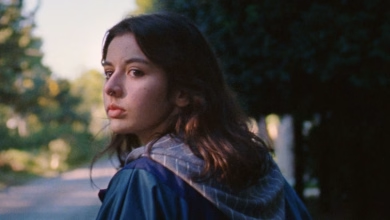
Cannes 2026 (Critics’ Week): The Station (dir. Sara Ishaq) | Review


“As men vanish into battlefields, women are left to hold society together.” The stage is set with this opening title card. In a Yemen scarred by self-perpetuating cycles of violence, fueled by a system that recruits boys from adolescence—if not childhood—offering them little beyond combat or death, women are not given leading roles. Except, of course, that of reproduction and, by extension, the production of future soldiers to fill the ranks of local military factions hungry for human lives. But that is about it. Reduced to invisibility, to modesty and restraint—and to all the restrictions that come with it, under the guise of preserving their beauty and purity—it is within the walls of Layal’s home that the village’s women find refuge.
No men, no weapons, no politics
Layal’s house doubles as a gas station, giving the film its title. But fuel flows far less abundantly than tea. In reality, her home feels more like a lively salon or restaurant, hidden behind a heavy iron gate that shields them from the neighbors’ gaze—though not from their watchful scrutiny.
No men, no weapons, no politics: the rules are simple, and they carve out—one hopes—a space of freedom within this colorful haven where women eat, talk, laugh, exchange illicit goods such as contraceptive pills, and build bonds of sorority that are both powerful and deeply moving. Amid this temporary escape, this breath of fresh air, Layal tries to protect her young brother from near-mandatory conscription starting at age twelve.
Round-faced, endearing, and close to his chameleon, Mr. Khirmish, Laith is clearly not ready for war. His older sister, with whom he now lives, is determined to spare him the same tragic fate as their brother. But to do so, she will have to rely on the help of another sister from whom they had grown apart.
A unique, generous, and deft blend of genres
Yemeni-Scottish filmmaker Sara Ishaq delivers an outstanding first feature: vibrant, elegantly shot, tightly written, and gripping throughout.
The Station blends genres in a way that feels both unusual and invigorating. The scenes unfolding within the station carry the energy of a colorful, uplifting comedy. In contrast to the enforced modesty imposed on the women, this vivid setting pays tribute to their vitality. At the same time, the film skillfully draws on the codes of the thriller and psychological drama, resulting in a tense narrative that mirrors the urgency of the characters’ lives.
From the moment the disruptive element enters the story, the film holds the viewer in suspense until its final second. The choice—and mastery—of thriller conventions proves particularly fitting for portraying the reality faced by Yemeni women, who carry the narrative. Under constant surveillance, caught in the grip of men and an oppressive system—made even harsher by tensions between rival factions—life becomes an obstacle course where every corner may conceal a threat. This is encapsulated in one of the final shots: a road cutting through a vast cemetery. Life hangs by a thread. One misstep, and it ends. In such a context, living—or even surviving—feels almost miraculous.
Society becomes a poison to itself
Notably, the film makes the deliberate choice not to show men. While military aircraft regularly tear across the sky and the war is ever-present, aside from the conscripted teenage boys, men remain off-screen—even when they are physically just inches from the camera. What we witness instead is a form of intimate, immediate violence, embodied by these forcibly recruited youths. This directorial choice renders the architects and mechanisms of the oppressive system intangible, making it all the more absurd. Invisible, diffuse, yet entirely structuring the women’s lives. As such, everything we observe—threatening behaviors, auxiliary figures aligned with different factions—is merely the product of a system that feeds itself.
As illustrated by the fate of one of the film’s most innocent characters, brutally trampled by a young soldier, violence here is often gratuitous, generated by the system itself. It becomes an outlet, a rite of passage, a proof of masculinity. It gives form, offers a way to exist—or simply to survive—by becoming, in turn, a toxic cog in the machine.
In this belligerent Yemen, society becomes poisonous to itself. Everyone must play a role, and to inhabit it, they must crush others. Young boys are expected to become soldiers, to scorn those who refuse conscription, to act like enforcers, to target the “weak”—and, of course, women who step outside the narrow freedoms granted to them. Survival means entering a perpetual cycle of violence: a veritable industry of death for boys sent to the front as early as twelve.

A sanctuary against oppression
Within this context, Layal’s station stands as a true sanctuary, managing—against all odds—to shield its visitors from the corruption outside. One of the film’s most striking scenes captures this perfectly: young Laith plays with a 13-year-old boy who has already been enlisted. One is a soldier, the other almost a deserter—belonging, moreover, to opposing factions. And yet, within this space, they simply play, like the children they are. They play at war, even as it rages outside for real. A scene that appears light on the surface, yet carries profound weight, reflecting the mirrored trajectories of these boys—trajectories that war prevents from ever truly meeting.
The Station is a film that resists easy categorization—gripping, generous, and deeply human. While war and corruption seep into every life, the film chooses to foreground the strength of sisterhood, the possibility of family reconciliation, and the preservation of human bonds. Sara Ishaq shows that connection can emerge beyond divisions, which are ultimately political and moral constructs. If the film is so vibrant, it is because life—and humanity—still push back against war and fragmentation.
In many ways, the Critics’ Week, where the film is celebrating its world premiere, mirrors the haven of the station: a space for expression, creation, and freedom, reflecting the world around it with generosity and a life force that makes you want to return again and again.
Our team is on site for the 79th Cannes Film Festival, from May 12 to 23, 2026.