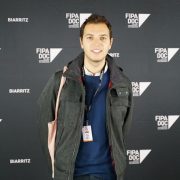
FIF Marrakech 2026: Bedeau, Transit Camp | Interview with Yohana Benattar


In an intimate and poetic gesture, Yohana Benattar follows the thread of a fragment of family memory, gradually bringing to light a buried and fragmented history: that of her grandfather and, through him, of thousands of Algerian Jews interned during the Second World War. With this poignant debut feature, the filmmaker takes us on a journey in search of truth and remembrance, while reconnecting with a family and collective past. A profoundly honest undertaking, imbued with a delicate poetic sensibility, the film is poised to move audiences at the Marrakech International Film Festival, where Bedeau, Transit Camp will celebrate its world premiere in the 11th Continent section.
What feeling predominates as you bring this film to completion, after such a long process of research, family introspection and the archaeology of memory?
Yohana Benattar: I feel deeply moved. After carrying this film with me for so many years, I’m really looking forward to letting it find its own life, its own path. I’m also very curious to see how audiences will make it their own.
The film begins with a song your grandfather used to hum. At what point did you realise that this seemingly small trace would open up such an extensive field of research? And that your personal quest would need to connect the intimate with the collective?
Yohana Benattar: It was in 2017 that I realised the song we used to sing together, laughing, was in fact connected to a possible experience of internment and forced labour. It took me many years to turn that realisation into research, and then into a film.
At first, I found it quite amusing to set off in search of the missing lyrics, to look for other people who knew the song. There was something rather funny about beginning a conversation with researchers or archivists by singing a song in the middle of vast corridors lined with dusty papers.
But once I began to grasp the sheer scale of the gaps in the historical record, and how little attention had been paid to those who had tried to give a voice to this unjust experience — which affected thousands of men and has never been fully acknowledged by the French state — I really felt the need to create something that could pass this history on to a wider audience.
How did you understand and navigate the responsibility that came with taking on the story of a collective memory?
Yohana Benattar: I don’t think I would use the expression “taking on” or “assuming responsibility for” that memory. I wanted to make this film into a place, a home, where people could meet, speak and question things. I wanted the film to raise more questions than it answered, and above all to crack open a certain existing collective memory — one in which I could neither recognise myself nor find the foundations to build my own identity.
On a formal level, your journeys through Algeria are imbued with poetry, metaphor and emotion. Was the intention to show how these journeys triggered a turning point, opening up new perspectives on how you understood and pursued your investigation?
Yohana Benattar: Since my first journeys there in 2022, everything in Algeria has been charged — even overcharged — with meaning. It was as though I had pulled on a thread and an immense space had opened up, allowing me to explore sixty years of absence and impossibility.
I had many almost magical experiences, extraordinary and deeply moving coincidences, which I didn’t include in the film because they would have been too much.
I think I undertook this investigation so that I could go to Algeria, rather than the other way around. Perhaps Bedeau was a doorway, or a key, that allowed me to do something my father had never permitted himself to do.
What do you believe is the power of documentary cinema to repair disrupted, buried or fragmented memories? And ultimately, to build a shared sense of belonging, reconciliation and common ground?
Yohana Benattar: Despite everything unjust and criminal that is happening around the world today, I still believe — perhaps against all odds — in the power of documentary cinema to bring people together, to tell different stories, or rather, to make us feel other perspectives and see things differently.
Documentary films have given me a great deal of strength personally, and have accompanied me on my journey for a long time. I’m thinking, for instance, of the films of Malek Bensmaïl, Alice Diop, Hassen Ferhani, and many others.
I believe documentary cinema has the power to create spaces for introspection, reflection and struggle. And hope is not a choice.
The 23rd edition of the Marrakech International Film Festival runs November 20–28, 2026.