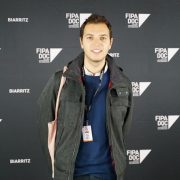
Interview with Denis Dobrovoda, director of ‘Savage’, a fictionalized account of human zoos


We interviewed Denis Dobrovoda on the message and making of Savage, a powerful, realistic, and thought-provoking short film on ethnological expositions, also known as human zoos, now playing on Directors Notes.
Savage is a 14-minute fictionalized account of a young African man brought to the UK at the turn of the 20th century to serve as an exhibit in a museum. He is examined, put on display, and abused in the name of science and imperialism. In this brilliantly crafted short film, director Denis Dobrovoda offers a glimpse into the sadly too oft-forgotten concept of human zoos that was part of the ugly fabric of Europe’s colonial endeavors and exemplified the racism that underpinned them.
We were delighted to interview Denis Dobrovoda, on the genesis and the making of Savage. Denis studied Philosophy, Politics, and Economics at the University of Oxford, and Film Directing at EICAR in Paris. Savage, his latest film, turned out to be popular on the film festival circuit, winning prizes and being presented in festivals like the San Diego International Film Festival (find the whole list of festival selections and awards below the interview). The film has also enjoyed educational screenings as well from anti-racism charities, and will be premiering online on 19 April 2021 on Directors Notes, after which it will be free to watch on the site.
“I remember being really shocked by the concept (of human zoos).”
Film Fest Report: How did you get interested in the old practice of human zoos? And why is it interesting to tackle this topic today?
Denis Dobrovoda: I first read about human zoos and colonial exhibitions at university, in a class on African politics. I remember being really shocked by the concept – and by the fact that I had never heard of it. At the time, almost ten years ago, I wasn’t really making films, but the topic was something that stayed with me over the years and I kept reading about it. I read virtually everything I could on the topic and the more I found out the more shocked I was by the fact that human zoos have largely disappeared from our historical education. And it just seemed to me that it’s a topic that should be revisited and reopened – many of the victims died of disease, bad hygiene, abuse and suicide, but as far as I know there are hardly any memorials for them anywhere. At one point I decided to try and write a script about it and that’s where Savage really started to take shape.
As for why the topic is important these days – I actually think what’s interesting is that with the film we were maybe a couple of years ahead of the curve and the big social debate on race that really took off last summer. I wrote the script in 2017 – and interestingly, right after the big BLM protests happened in 2020, Savage won two awards at a couple of festivals in the United States, which is the country where it generally did very well – unlike in the UK and the rest of Europe, where it has gone largely unnoticed. I think that the film fits quite well into this new found desire to explore the history of Western imperialism and colonialism.
Film Fest Report: There seems to be an interesting mix of genres in Savage, a drama which looks a little like a comedy at times. How did you approach the translation of your interest in human zoos into a screenplay, and eventually into the film?
Denis Dobrovoda: The process was actually relatively straightforward – as I was reading articles and books on the topic I was taking notes. The script itself is essentially a structured telling of a story that combines the different events and facts that stood out the most to me. I would like to stress that it is one hundred percent realistic – practically nothing is made up. The singing of the British imperialist song, horse meat, measuring skulls and body parts, signing a bogus contract – all of this happened. In particular the character of the museum guide is interesting from the point of view of my research – because almost everything he says is taken word for word from historical sources.
And it’s important to say that the film is not an exaggeration – if anything, compare to the most extreme cases, it is quite mild. For example in 1905 a man called Ota Benga was put in the pavilion of apes in the Bronx Zoo – and he became the most visited attraction they had ever had up to that point, a real sensation. And the exhibition was greatly praised by the New York Times at the time – and there are millions of small facts and stories like that, which have been forgotten…
Film Fest Report: You have assembled and worked with an excellent cast. Was it challenging to work with them on such a touchy topic?
Denis Dobrovoda: Yes, especially for Florence (Nzenwefi), who played the main character Mokonzi, the film was emotionally really challenging. He is an exceptional talent, and he essentially lived in character during the shoot, but I can’t even imagine how difficult that must have been. You would also have to ask him, but I felt like we were both on a very similar wave length – in terms of what we were making, what significance it had, and where we were trying to take it. But for me, working with him was very special. I agree that the other actors did a great job as well. James, who played the museum guide was excellent, but it’s not surprising – he’s worked with Steven Spielberg for example, so he really knows what he is doing.
“My biggest fear before releasing the film was how black and ethnic minority viewers would react.”
Film Fest Report: The cinematography is stunning. Can you explain your choice of the 4:3 aspect ratio?
The cinematography is the work of the phenomenal Andrew Alderslade, an amazing London-based Director of Photography. The idea we discussed was giving the film a look that would consciously diverge from the classic period dramas you see on Netflix. That’s why the lighting and the ambiance is all cold and harsh – as opposed to the warm look most historical fiction uses. It makes the environment even more hostile for the main character – and also makes his death from some kind of an illness believable. We also decided to use the 4:3 aspect ratio, which was used at the dawn of cinema. In that we were referencing the films by the Lumiere brothers for example, who actually shot one of their earliest films at one of the colonial exhibitions in Paris, and I think it’s on YouTube for everyone to watch.
Film Fest Report: The film has had a great career on the film festival circuit. Which message did you want to share with the audience? And what kind of feedback did you get from them?
Denis Dobrovoda: I think the message was quite simple – to bring to light a part of history that the audiences most likely aren’t aware of – and perhaps use that insight into the way they think about history more generally. I think that from the feedback we’ve had it seems to me that the film does achieve that goal. The vast majority of people who have seen it have told me they’d never heard of human zoos, and the general reactions was that of shock. My biggest fear before releasing the film was how black and ethnic minority viewers would react – the topic is extremely sensitive and raw, and I am a white, Eastern European director… But actually, I haven’t had any problems with that, and the reactions have been positive.
“‘Savage’ taught me a huge amount, it helped me grow in every way as a filmmaker.”
Film Fest Report: Can you tell us about your next projects? Have you learnt something while making Savage that will help you in the future?
Denis Dobrovoda: Savage taught me a huge amount, it helped me grow in every way as a filmmaker. I don’t think there is one single lesson from it – but more of a general development that it brought me. But it was also a hugely stressful project, which perhaps explains why I haven’t done much fiction since then! So in terms of my next fiction project – there isn’t one at the moment, I haven’t felt like I’ve connected with any of the topics I have recently been exploring enough to actually start writing something. But I am working a lot in documentary these days. I am in post-production on my first documentary feature, and am also in development on a one hour TV doc. Both of them are exciting projects and there has already been some interest in the feature, so with a bit of a luck, this could be a good year for me!
We wish to thank Denis Dobrovoda and Abla Kandalaft for their time and kindness.