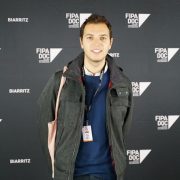
Tense, generous and exhilarating, Marion Le Corroller’s debut feature, Species, made its mark on the Croisette last May. Led by a magnetic performance from Mara Taquin, the film depicts a society warped by work, consumed by the pressure to perform, relentless demands and the need to conform. It is an oppressive system that people willingly bow to in order to carve out a place for themselves, only to find that it ultimately disfigures and crushes their bodies. Le Corroller’s body horror is both exuberant and biting, drawing us into a colourful, nightmarish machine.
On the occasion of the film’s Quebec premiere at the CINEMANIA Festival, we had the chance to speak with the first-time filmmaker, whose film draws in large part on her own firsthand experience of a contemporary malaise that has younger generations caught in a vice-like grip.
Marion Le Corroller traces the origins of the film back to the beginning of her professional career: “Before getting into filmmaking, I spent five years studying finance, but I never managed to adapt to that environment. I was highly sensitive in a world where you absolutely couldn’t show any sensitivity, where you had to be tough. It was an environment in which individual differences simply didn’t matter.”

The cynicism of a world driven solely by performance eventually undermined her desire to do well: “The most important thing was whether we could make money for the company. So I was experiencing both physical and psychological distress.”
After walking away, Marion Le Corroller realised that her experience was far from unique: “It’s really a generational issue.” A taboo rooted in “the disillusionment young people experience when they enter the job market. […] I felt that we couldn’t talk about it, that this distress was impossible to put into words.” This is where the filmmaker found a connection with body horror: “I thought it would be interesting to film bodies as a way of telling the story of society’s ills. To show the body as a reflection of what we go through, as something that betrays us and begins to transform.”
This physical manifestation of psychological distress takes hold of bodies across professional environments, from trading floors and newsrooms to fast-food restaurants and emergency departments. Although these professions are very different by nature, they are now subject to much the same pressure and obsession with performance. “Today, emergency services and public hospitals are run like CAC 40 companies and fast-food chains,” the filmmaker explains. “Services have to be profitable. Time wasted must be reduced. Every minute is monetised. What interested me, then, was showing precisely how this demand for hyper-productivity and performance bears down on our bodies.”

This led her to shape the film’s production design around the idea of subjugating and tormenting its characters: “I imagined the hospital as a monster, as a character in its own right, as an organic substance, a living being ready to swallow the characters who would find themselves deep in its bowels.”
The starkness of the hospital set’s brutalist architecture, combined with the violence of the red lights slashing across it, perfectly serves this purpose. So does its spatial design: “For me, the inside of the hospital is the inside of an enormous belly, with its guts, its entirely red corridors, and, of course, the idea of getting the characters lost in there and completely crushing them, either through top shots or wide-angle shots.” The characters are thus shown trapped inside this nightmarish machine. “I wanted to make this place as terrifying and claustrophobic as possible.”
This sense of mounting momentum and inevitability is reinforced by the film’s score, composed by ROB. “We really wanted to create something very danceable, very uplifting. We absolutely didn’t want to go down the route of a conventional horror film score. We wanted something that stood out, that felt young and that could sometimes create a sense of distance from what we were seeing on screen.”
At the heart of this deeply anxiety-inducing environment, Belgian actress Mara Taquin proves magnetic from beginning to end. “Mara is incredibly resilient and determined. She’s a tremendous hard worker, someone who is extremely committed and wasn’t afraid to put in some really hard work.” Grateful for her actress’s dedication, Marion Le Corroller adds: “She had never worked in genre cinema before, so she was very curious to discover that world.” She continues, full of praise: “Mara has tremendous acting instincts, but also great sensitivity and a real thirst for learning. […] She plays a very courageous and persevering character, and Mara is exactly like that in real life, too.”

Species is also framed by a striking opening scene in which a fast-food worker explodes under unbearable pressure. It serves as both a statement of intent and, quite aptly, a teaser for the film itself. The story then concludes with a clever, offbeat final scene that fully embraces the premise established throughout the film. Marion Le Corroller explains: “I really wanted to have two separate vignettes at the beginning and the end, which would echo one another while remaining distinct from the rest of the film. […] I thought it was quite interesting to have these two scenes work as mirror images of each other, and above all, to end on a humorous note.”
As Species continues its festival run and theatrical release, its director is already looking ahead to what comes next. “It’s a first film, so there’s a certain innocence to it, and a sense that you have nothing to lose. After all, nobody knows you, so nobody has any expectations of you. You have no limits, so you try all sorts of things. Your set becomes a laboratory. And I don’t know whether I’ll have quite the same freedom, or at least the same carefree attitude, when I make my second film.” Her next feature will indeed be a horror film, she tells us, but not a body horror film. As she puts it: “As a filmmaker, you shouldn’t box yourself into one type of film. On the contrary, you should remain curious and be willing to experiment with all sorts of things.”
The 32nd edition of the CINEMANIA Festival runs November 4–15, 2026.