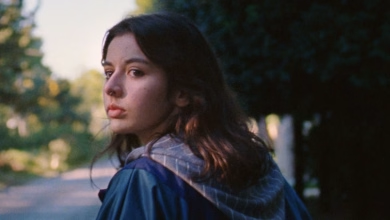
Venice 2024: Don’t Cry, Butterfly | Interview of Award Winner Duong Dieu Linh


We met Duong Dieu Linh, director of Don’t Cry, Butterfly, top winner of the Settimana Internazionale della Critica at the 81st Venice Film Festival.
In a suburban town near Hanoi in the early 2000s, housewife Tam discovers her husband’s infidelity. Rather than confronting him directly, she resorts to a peculiar form of voodoo to rekindle his love, only to spawn something unexpected within their home. This is the captivating premise of Don’t Cry, Butterfly, the debut feature film from Vietnamese director Dương Diệu Linh. The film premiered at the 2024 Venice Film Festival, where it triumphed in the Venice Critics’ Week, winning both the Grand prize and the award for the most innovative feature.
Dương Diệu Linh’s experience of growing up in an environment marked by absent father figures led her to explore deeper themes of self-inflicted entrapment and internalized misogyny. Through the character of Tam, Linh poses critical questions about where women place their expectations for happiness and whether they are truly addressing the root causes of their misery. She suggests that both men and women might be victims of a ruthless and vicious social system rather than each other.
Before hitting Venice with her debut feature, Linh Dương has garnered acclaim for her unconventional portrayals of sad, angsty, and nagging middle-aged women. Her shorts, which blend quirky humor with magical realism, have competed and won awards at prestigious film festivals globally. Linh’s journey with Don’t Cry, Butterfly began with its development winning the Moulin D’andé-CECI Award at Locarno Open Doors 2019 and its selection for Full Circle Lab 2020.
We were delighted to sit down with the director in Venice, to delve into her inspirations, the evolution of feminism, and the generational dynamics portrayed in the film.

Ramona Boban-Vlahović: What is the film about and what inspired you to tell the story?
Dương Diệu Linh: Ten years ago, I wrote this short film script. It’s about a mother and a daughter, and they’re also dealing with womanhood and the disconnection between two different female generations. And how they don’t communicate with each other, but they do love each other so much. I felt that the film was special for me. It was hilarious, but at the same time bittersweet. But I felt that it wasn’t long enough for me to tell everything that I want to tell with all the vicious cycles that different generations of women have to go through, the generational trauma that they pass down from one to another without being aware of it, the societal expectations of how a woman should behave, how a family should function, how one is supposed to be a mother, a father, and a daughter. How they should behave without considering all the emotions that a human should have.
This idea for Don’t Cry, Butterfly came about in 2019 when I felt comfortable enough to tackle this topic again. I was sure that with a feature film, I would be able to tell all that I want to say about being a woman in society. I’m quite happy that I managed to portray how two women from two generations, one thinking they are better than the other and escaping, but in the end, both of them, slightly delusional, fall into escapism in their own ways, separate from each other but very well connected.
Ramona Boban-Vlahović: You speak so beautifully about it. Do you believe that this difference is a generational one, or is it the fact that feminism has evolved? Do you think it’s always going to be the age difference that causes the clash between perceptions of womanhood, or are we really evolving with each generation?
Dương Diệu Linh: I think these differences have to do with both generational differences and the evolution of feminism. I mean, who has a good relationship with their mother? We always go through the phase of thinking, “I can do it better than you. I will not become like my mother,” only to realize that you are becoming your mother at a certain age. And then, “Oh yes, my mother was right,” but only when you’re proud that you’re becoming your mother.
For the characters in the film, one is in her forties and the other is in her twenties, and the daughter is at that rebellious age. I felt it would be interesting to see how the daughter, with her naive view of the world, thinks she is doing better than the mother or finding a solution different from what the mother is going through without understanding what the mother has to go through. This ties into the generational trauma, especially in Vietnam, a patriarchal country with a set of rules about how women should be supportive of their husbands and sons. Even without a son, there is still a traditional family model to uphold.
But we do evolve with time. In our grandparents’ era, women mostly stayed at home and took care of children. In the film, the woman has to work, take care of her husband, and worry about her daughter. She’s picking up all these roles, moving around the house quickly with a checklist to finish every day, without letting the husband help because it’s too much mental baggage to tell someone what to do. The husband is not helpful, slow-moving in his own pace, comfortable without observing what the wife is going through or if she needs help. This is a common problem in modern society, where women take on more roles inside and outside the family while men maintain old ways without equipping themselves to support their wives emotionally and take on that emotional baggage.
Ramona Boban-Vlahović: The daughter is interesting because she witnesses everything happening in the family and is supposed to be the new, innovative generation seeing beyond the confines of the house. But she’s still naive because she’s only 20 years old. How did you explore her attempts to be different from her mother?
Dương Diệu Linh: I explored how she tries to be different from her mother but ends up doing the same thing. There’s no escape, just elaboration. None of the characters in the film communicate what they really feel. The daughter complains to her friends about her parents but doesn’t tell them what she feels either. Without communication, how do you expect to solve a problem? This leads to broken marriages and family relationships.
Ramona Boban-Vlahović: Well, I guess one feeds the other. Relationship issues wouldn’t exist without communication. But I wanted to ask you about your visual style. It is so bright and unique. Was it your decision to make it specifically Vietnamese without an international polished feel?
Dương Diệu Linh: For me, cinematography and visual arts, including production design, should help tell the story and enhance the film’s meaning. In this film, I wanted the mother to be trapped not only within her house but also within her workplace and whenever she goes out. She’s always squeezed physically by the bulky wooden furniture in the cramped house and by people. She’s never alone, always surrounded by chaos or furniture, giving a sense of suffocation. This was clear from the beginning, and I told my production designer and DP to follow the main character’s emotions. Even the camera work follows the scene’s emotion and the story’s needs, whether handheld or observational.
Ramona Boban-Vlahović: There’s a lot of symbolism in the film. Is there anything specific that might not be easily understandable to European audiences?
Dương Diệu Linh: I have a personal interest in body horror, influenced by David Cronenberg and John Carpenter. Body horror helps portray extreme, unspoken human emotions. The creature in the film ties to a Vietnamese idiom that a house leaks from the roof, meaning if the head of the family (the man) is not functioning well, the whole household will crumble. This got me thinking about the leak in the house being treated as trivial or ignored until it requires major repairs, similar to how the wife deals with her husband’s affair. Avoiding problems leads to escalation and consumption, just like the leak becoming a creature that confronts the wife.
Ramona Boban-Vlahović: To finish, what is the message you wanted to send with this film in one sentence?
Dương Diệu Linh: I want women and men to study relationship dynamics and for women to not just think of themselves as victims of men, but to reflect on their actions and whether they are looking for happiness in the right place, rather than placing their happiness in something external like men, without considering what makes them complete as women.
Make sure to watch the full interview here.
Read our review of Don’t Cry, Butterfly and explore our exclusive coverage of the 81st Venice International Film Festival here.